

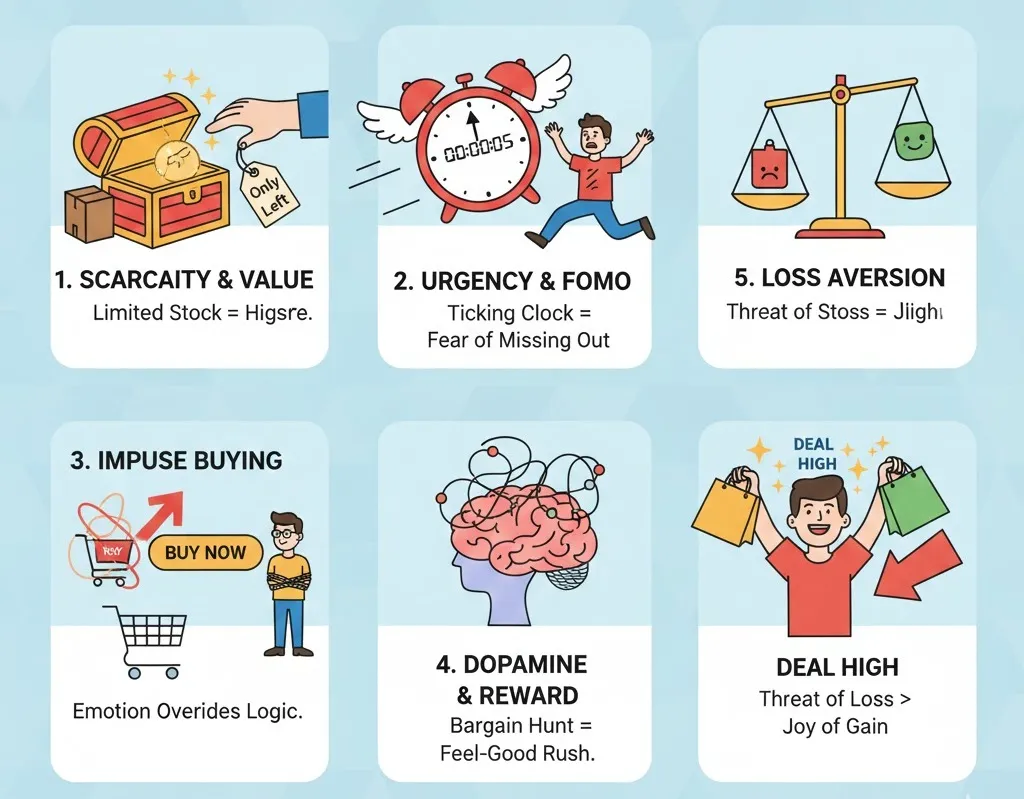
Here are the 5 key reasons why flash sales work so effectively, summed up in bullets:
- They Create Scarcity, Making Items Feel More Valuable Limited availability or time tricks our brains into seeing the product as more desirable and exclusive, pushing us to grab it before it’s gone.
- They Trigger Urgency and Fear of Missing Out (FOMO) The ticking clock ramps up pressure, making us worry we’ll regret not acting, which overrides slower, more thoughtful decision-making.
- They Spark Impulse Buying by Short-Circuiting Rational Choices Short deadlines reduce time for weighing pros and cons, leading to emotional, spontaneous purchases instead of logical ones.
- They Release Dopamine, Giving That “Deal High” Snagging a bargain floods the brain with feel-good chemicals, creating a rewarding rush that makes shopping during flash sales addictive.
- They Leverage Loss Aversion, Where Missing Out Hurts More Than Gaining We’re wired to hate losses more than we love gains, so the threat of a deal disappearing feels painfully urgent, driving quick action.
Flash sales compress the entire shopping journey into a tiny window. A timer ticks down, stock numbers drop, and shoppers feel a spike of urgency. That combination changes how people judge value, pushing them toward faster decisions. Retailers use this format because it consistently grabs attention and encourages action.
Flash sales, those limited-time blasts of deals, aren’t just random marketing tricks—they’re backed by psychology and consumer behavior studies. I’ll break down five key reasons why they work so well, each pulled from real research. For each one, I’ll explain the science, back it up with specific studies, and give a real-world example of how it plays out. Let’s get into it.
Most Common 5 Reasons:
Reason 1: They Create Scarcity, Making Items Feel More Valuable
When something’s only available in limited quantities or for a short time, our brains perceive it as more desirable—even if it’s not that rare. This scarcity principle flips a switch in us, pushing us to act fast because we hate the idea of missing out on something “special.”
The research backs this up: A meta-analysis of 416 effects from 131 studies found that demand-based scarcity (like “only 5 left!”) works best for practical products, boosting purchase intent by making them seem exclusive (“Scarcity tactics in marketing: A meta-analysis of product type effects,” Journal of Retailing, 2022).
Example: Think of a site like Amazon during Prime Day—when they show “Limited stock: 3 left at this price,” shoppers often add to cart immediately, even if they weren’t planning to buy, just to secure it before it’s gone.
Reason 2: They Trigger Urgency and Fear of Missing Out (FOMO)
Time limits create a ticking clock in your head, ramping up pressure to decide now rather than later. This urgency overrides our usual careful thinking, leading to quicker buys because we worry the deal won’t come back.
A classic piece on this explains how carefully timed expirations spark social buzz and a sense of regret if you don’t act, driving impulse through psychological pressure (“Why Limited-Time Offers Entice Shoppers to Buy,” Psychology Today, 2019). Another study dives deeper, showing how urgency biases decisions via loss aversion, where the pain of missing a deal feels worse than overpaying a bit (“Scarcity Effect and Consumer Decision Biases: How Urgency Influences Judgment,” Journal of World Economy, 2024).
Example: Brands like Shein or ASOS run “Flash Sale: Ends in 30 Minutes!” pop-ups. A shopper eyeing a dress might hesitate normally, but with the timer counting down, they checkout fast to avoid that nagging “what if it’s sold out tomorrow?” feeling.
Reason 3: They Spark Impulse Buying by Short-Circuiting Rational Choices
Flash sales cut down the time we have to weigh pros and cons, encouraging snap decisions based on emotion rather than logic. This leads to more spontaneous purchases, especially in online shopping where everything’s just a click away.
Research shows flash sales positively influence consumer behavior by creating time-limited pressure that boosts instant orders, though it can backfire if overused (“Uncovering the negative impact of flash sales on instant order decisions: The role of time pressure,” Journal of Business Research, 2025). A systematic review of impulse buying in flash sales contexts confirms this, noting how scarcity cues in e-commerce drive up to 40% of unplanned buys (“Impulse buying in live streaming e-commerce: A systematic literature review,” Computers in Human Behavior, 2025).
Example: On platforms like TikTok Shop, a flash sale with “50% off for the next hour + free shipping” might make you grab trendy gadgets you saw in a video, without checking reviews or comparing prices—pure impulse fueled by the deadline.
Reason 4: They Release Dopamine, Giving That “Deal High”
Scoring a bargain lights up the reward centers in your brain, releasing feel-good chemicals like dopamine. Flash sales amp this up by combining the thrill of a win with the urgency of snagging it before it’s gone, making shopping addictive.
Studies link this to how anticipating rewards (like a discount) triggers dopamine spikes, similar to other pleasures, which reinforces the behavior (“Dopamine: The pathway to pleasure,” Harvard Health Publishing, 2022). Behavioral economics research adds that saving money specifically releases dopamine and oxytocin, tying into trust and happiness during deals (“Leveraging the Psychology of Discounts to Make More Money,” Volusion Blog, 2015—updated insights in 2025 editions).
Example: During a site’s “Lightning Deal” on electronics, like a discounted smartwatch, the moment you claim it feels euphoric—like winning a mini lottery. Shoppers often report browsing more after, chasing that next hit.
Reason 5: They Leverage Loss Aversion, Where Missing Out Hurts More Than Gaining
We’re wired to avoid losses more than we seek gains, so the threat of a deal vanishing makes us overvalue it. Flash sales exploit this by framing the discount as a “limited opportunity” you’ll regret passing up.
This is supported by work on how limited-time offers tap into loss aversion, making consumers act irrationally to avoid missing out, even if the item’s not essential (“The Psychology of Scarcity: Using Limited-Time Offers (Without the Ick Factor),” Spri.ng Blog, 2025). A broader analysis shows urgency amplifies biases like this in buying decisions (“A Meta-Analysis of Online Impulsive Buying and the Moderating Role of Economic Development Level,” Cyberpsychology, Behavior, and Social Networking, 2021).
Example: Airlines like Ryanair use “Sale Ends Midnight: Seats Filling Fast!” emails. Even if you weren’t planning a trip, the fear of prices jumping tomorrow might push you to book, prioritizing avoiding the “loss” over actual need.
There you have it—these aren’t just gimmicks; they’re rooted in how our minds handle pressure, rewards, and fear. Next time a flash sale pops up, you’ll know exactly why it’s so tempting. If you’re running a business or just curious about more marketing psych, what’s your take?
Why scarcity shifts thinking
Scarcity alters the way people evaluate offers. When a product shows a “low stock” indicator or the timer shows only a short window, shoppers expect competition. That rise in perceived demand changes perceived value. Instead of scanning for alternatives or checking price trends, the primary question becomes “Will this be gone soon?”
This is a form of anchored judgment. The advertised sale price becomes the reference point because there is not enough time for a detailed comparison. Flash formats rely on this quick pivot in attention, and it works because the mind switches from analysis to opportunity tracking.
To keep up with these limited-time opportunities, some buyers prepare their balance ahead of time. Many choose to add credit through a simple top-up method so they can move quickly when a promotion appears. For example, someone may buy PayPal top up on Eneba before a major event, so checkout becomes instant when the discount goes live.
Emotional drivers that spark quick decisions
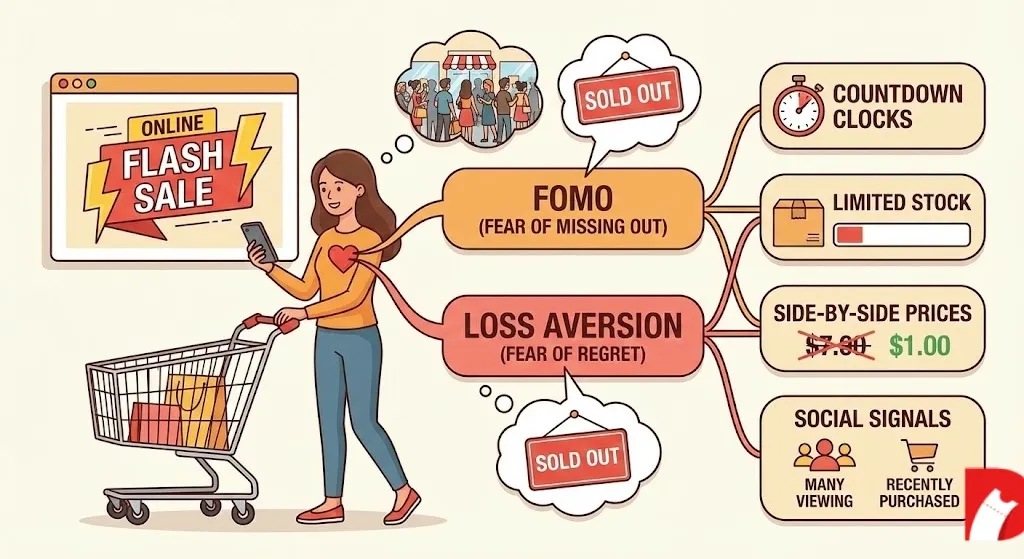
Two core psychological effects shape how shoppers react in these events: the desire to avoid missing out and the discomfort of potential loss.
- FOMO appears when platforms show signs of activity. Notifications like “many people are viewing this” or active stock counters introduce a social element. Even if the viewer was not planning to buy, the impression of rising demand can push them toward the basket.
- Loss aversion amplifies this effect. People tend to feel the pain of losing a deal more intensely than the satisfaction of passing it up. When a discount lasts only minutes, the possibility of regret becomes stronger than the desire to research alternatives. This emotional imbalance is deliberate, and businesses use it because it reliably increases short-term conversions.
The core tools behind every flash sale
- Countdown clocks
- Limited stock indicators
- Side-by-side price displays
- Social signals that show real-time activity
These tools appear simple, yet each one touches a separate part of the decision-making process.
How buyers adapt without overspending?
Experienced shoppers learn to approach flash events with structure. Instead of jumping at every discount, they build a rhythm that keeps impulse spending under control. Many set monthly budgets, track upcoming promotions or keep a small prepaid balance ready for items they already planned to buy. Once that balance is set, decision-making becomes easier because the limit is already defined.
Prepaid funds also add friction that protects shoppers. Loading a fixed amount forces them to think within clear boundaries. That pause can prevent unnecessary purchases and guide attention toward items with real value.
- Scarcity tactics in marketing: A meta-analysis of product type effects – https://www.sciencedirect.com/science/article/pii/S0022435922000434
- Why Limited-Time Offers Entice Shoppers to Buy – https://www.psychologytoday.com/us/blog/the-science-behind-behavior/201906/why-limited-time-offers-entice-shoppers-buy
- Scarcity Effect and Consumer Decision Biases: How Urgency Influences Judgment – https://www.pioneerpublisher.com/jwe/article/view/1095
- Uncovering the negative impact of flash sales on instant order decisions: The role of time pressure – https://www.sciencedirect.com/science/article/abs/pii/S0148296325007052
- Impulse buying in live streaming e-commerce: A systematic literature review – https://www.sciencedirect.com/science/article/pii/S2451958825000910
- Dopamine: The pathway to pleasure – https://www.health.harvard.edu/mind-and-mood/dopamine-the-pathway-to-pleasure
- Leveraging the Psychology of Discounts to Make More Money – https://www.volusion.com/blog/using-the-psychology-of-discounts-to-make-more-money/
- The Psychology of Scarcity: Using Limited-Time Offers (Without the Ick Factor) – https://blog.spri.ng/index.php/2025/02/04/the-psychology-of-scarcity-using-limited-time-offers-without-the-ick-factor/
- A Meta-Analysis of Online Impulsive Buying and the Moderating Role of Economic Development Level – https://pmc.ncbi.nlm.nih.gov/articles/PMC8355873/


