

There’s a narrative floating around that voucher sites are finished. Done. Relics of a simpler internet, about to be bulldozed by gamified mystery box platforms and interactive deal apps that turn shopping into something closer to a game show.
It’s a neat story. Makes for punchy headlines. And it’s almost entirely wrong.
I tested it the most obvious way possible — by doing what millions of shoppers do every single day. Typed “Deliveroo discount code” into Google’s AI Mode and “Funky Pigeon Discount Codes” into ChatGPT, then sat back and watched where the answers came from.
What AI Actually Pulls When You Search for Deals
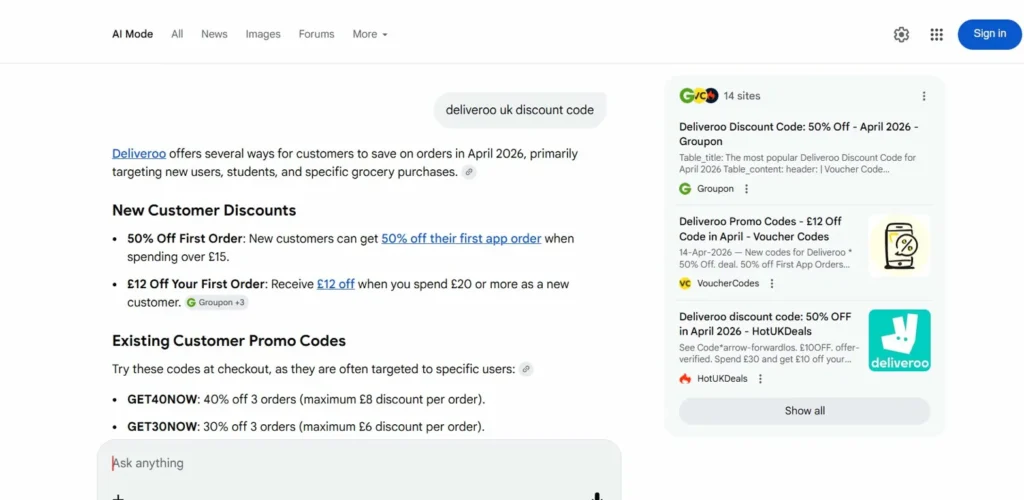
Google’s AI Mode didn’t send me to a mystery box site. Didn’t suggest I spin a wheel or open a loot crate. It pulled working promo codes — 50% off first orders, £12 off for new customers, GET40NOW for 40% off — sourced directly from Groupon, VoucherCodes, and HotUKDeals. Three traditional voucher aggregators. Cited by name, linked at the side, codes ready to copy.
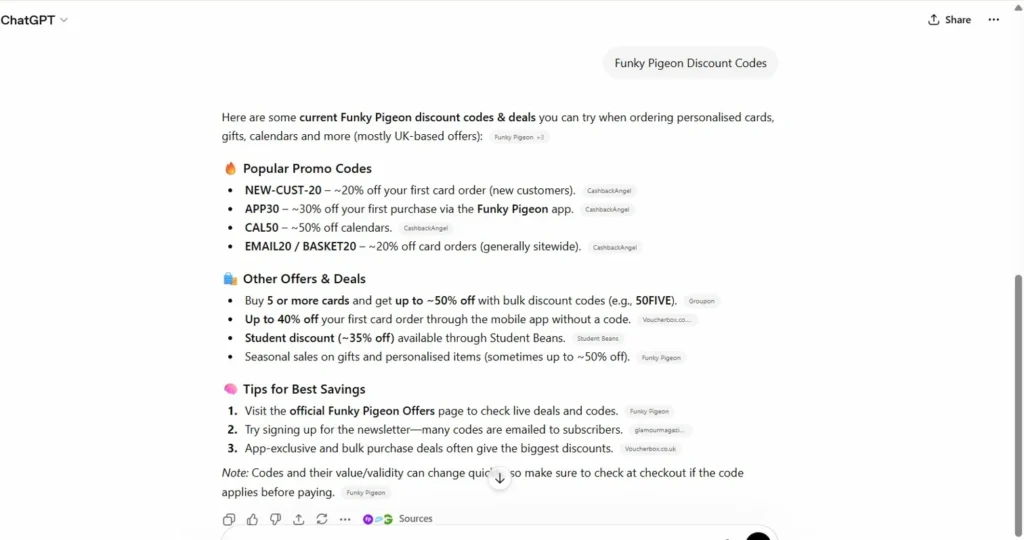
Same thing with ChatGPT. Asked for Funky Pigeon codes and got a structured breakdown — NEW-CUST-20 for 20% off, APP30 for 30% off via the app, CAL50 for 50% off calendars — pulled from CashbackAngel, Voucherbox, Student Beans. Even included tips like checking the official offers page and signing up for the newsletter.
No gamification. No mystery. Just codes, sources, and instructions.
If voucher sites were dying, AI wouldn’t be training itself on their data. The fact that every major AI assistant — Google, ChatGPT, Bing Copilot, Perplexity — defaults to voucher aggregators when someone asks for a deal tells you exactly where the value still sits.
Why This Matters More Than It Looks
Something to sit and ponder over. These AI systems are not merely scraping voucher sites, they are constructing their shopping intelligence on them. The trail of citation when Google AI Mode responds to a query on discounts is Groupon, HotUKDeals, VoucherCodes and other websites. And that is no accident. That’s architecture.
The gruntwork has been done by voucher sites over the years: checking their codes, and classifying their stores, following expiry dates, and creating user communities that vote on what works and what goes out of date. It is precisely that organized, validated data that AI models require to provide useful responses.
Try asking any AI assistant “what mystery box should I open on Hypedrop right now?”
The answer is going to be watered down, equivocal, and most likely contain a gambling warning. Since it has no organized, verifiable data to draw on. Mystery box value proposition is by definition unpredictable, it is the entire point of mystery box, and therefore, there is not much that AI can do about it.
Voucher codes are in reverse. They are precise, verifiable, and binary – it either works or it doesn’t. That is what makes them ideal training data to AI shopping assistants, and why conventional platforms of deals are getting more relevant in the AI age, rather than less.
So What Do Interactive Platforms Actually Offer?
None of this means gamified shopping platforms are worthless. They’re just doing something fundamentally different.
Platforms like Hypedrop’s online deals operate on a mystery box model — you pick a box at a price point, open it, and receive a random product. Could be AirPods, could be a PlayStation 5, could be something you didn’t want at all. If you’re not happy with what you got, you swap it for site credit and try again. Some platforms add PvP battles where you wager your item against another player’s for a chance at something better.
It’s entertainment-first shopping. The value isn’t “I need a specific product at the best price.” It’s “I want to see what I get.” Different motivation, different audience, different dopamine hit entirely.
And for some people, that’s genuinely fun. Same way scratch cards are fun, or lucky dip at the local fête, or bidding on storage units without knowing what’s inside. There’s a reason these mechanics have existed in various forms for centuries — the thrill of the unknown is a legitimate form of entertainment.
But it’s not a replacement for knowing exactly what you want and finding the cheapest way to get it. Somebody searching “Deliveroo discount code” doesn’t want a surprise. They want 40% off their Friday night chicken tikka. Those are completely different shopping moments, and pretending one is replacing the other misses the point of both.
The Honest Comparison
| Question: | Traditional Voucher Sites | Interactive Deal Platforms |
|---|---|---|
| What you’re doing | Searching for a specific discount on a known product or store | Browsing, playing, discovering random products |
| What you get | A code that gives a known discount on something you already want | A random item from a price-tier box — could be great, could be irrelevant |
| Price certainty | You know exactly what you’ll pay before checkout | You know the box price, but not the item value you’ll receive |
| AI assistant compatibility | High — codes are structured, verifiable, and cited by Google AI, ChatGPT, Perplexity | Low — random outcomes can’t be indexed or recommended by AI |
| Best for | “I need this specific thing cheaper” | “I want to see what I can get” |
| Risk level | Near zero — worst case, the code doesn’t work and you pay full price | Variable — you might get something worth less than what you paid for the box |
| Repeat value | High — new codes refresh weekly/monthly, same stores | Depends on platform — credit-swap mechanics can extend value |
| How it makes money | Affiliate commissions from retailer links | Margin between box price and average item value |
| Who it suits | Budget-conscious shoppers, planned purchases, deal hunters | Entertainment shoppers, impulse browsers, collectors |
| Engagement model | Search → find → apply → save | Browse → gamble → reveal → keep or swap |
Five Shopping Scenarios — Which One Wins?
Not everything needs a versus. Sometimes it’s about picking the right tool for the moment.
“I need 20% off my ASOS order before checkout” Winner: Voucher site. You’ve got items in your basket, you need a code, you need it now. Search, copy, paste, save. A mystery box isn’t helping here.
“I’m bored on a Saturday afternoon and want to treat myself to something random under £20” Winner: Interactive platform. You’re not shopping for anything specific. You want the dopamine of opening something and being surprised. That’s exactly what mystery boxes are built for.
“I want to compare broadband deals and switch provider” Winner: Voucher/comparison site. This needs structured data — prices, speeds, contract lengths, cashback offers. AI assistants pull this from comparison and deal sites, not from gamified platforms.
“I’m looking for a birthday gift and have no idea what to buy” Winner: Could go either way. A mystery box might land you something unexpectedly perfect. A voucher site might give you 30% off the safe option you’d have bought anyway. Depends on whether you trust luck or planning.
“I want the absolute lowest price on a specific pair of trainers” Winner: Voucher site + cashback stack. Search the model, find the code, layer a cashback portal on top, maybe wait for a seasonal sale. This is precision e-commerce — and it’s the opposite of randomised discovery.
The Verdict
Voucher sites aren’t being outpaced by anything. Instead, they are becoming further integrated into the shopping mechanism, both by using direct visits, but also as the data foundation that AI assistants use to process millions of deal queries daily. That’s not a dying industry. That’s infrastructure.
Interactive deal sites have already established a real niche and at the opportune time, when someone just needs to passively browse, give a surprise present, or simply have the fun of not knowing what you will get, they can provide what the voucher sites are unable. Well done to them.
But the idea that one is replacing the other? That mystery boxes are making discount codes obsolete?
As any bargain hunter worth their salt knows: you don’t bring a lucky dip to a price comparison. Different tools for different jobs. And the one that’s being woven into the fabric of AI-powered shopping isn’t the mystery box — it’s the humble, unglamorous, endlessly useful voucher code.


