

There’s a reason good poker players tend to be irritatingly sensible with money. Not because they’re tight — plenty of them will happily drop a few hundred quid on a night out — but because the game drills certain thinking patterns into your head that are nearly impossible to switch off.
Evaluating what something is actually worth. Knowing when to walk away from a bad situation. Calculating whether a risk is genuinely worth taking. These aren’t just card table skills. They’re the same mental habits that stop someone falling for a “70% off” sign that’s really just normal pricing with extra steps.
The overlap isn’t coincidental. Behavioural economists have spent decades studying why humans make terrible decisions under pressure, and poker players — whether they’ve read the research or not — learn to sidestep the same traps through sheer repetition.
Here’s how those betting instincts translate to not getting mugged off at the checkout.
Spotting Real Value When Everything Looks Like a Bargain
What poker players do at the table
I’m sitting with a pair of jacks. Looks decent. Feels decent. But decent compared to what?
Good players don’t evaluate hands in isolation. They’re thinking about position, what others might be holding, how the hand plays on different board textures. A pair of jacks is strong in some spots and a trap in others. The cards haven’t changed — the context has.
This is where amateurs get burned. They see a hand that looks good and commit too early, without asking whether “good” means anything given what’s actually happening around them.
How this applies to shopping
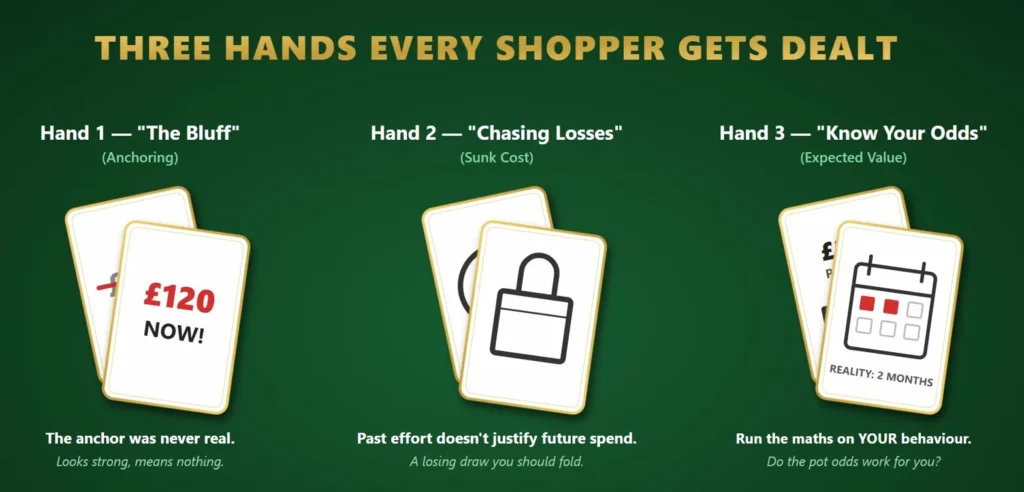
I’m staring at a jacket marked down from £200 to £120. My brain is screaming bargain. Forty percent off. That’s proper savings.
Except here’s the thing: that £200 was never real.
Daniel Kahneman and Amos Tversky identified this in 1974 and called it anchoring bias. The first number you see — the anchor — shapes how you evaluate everything that follows. Retailers know this. They inflate the “was” price specifically so the “now” price feels like a steal.
The jacket might be worth £120. It might be worth £80. But once that £200 plants itself in your head, you stop asking. You’re not evaluating the jacket anymore. You’re evaluating the gap between two numbers, and one of them was made up.
The poker habit that helps: Treat the “original price” like an opponent’s bluff. It’s information designed to manipulate your decision, not inform it. Ask what you’d pay if there was no crossed-out number at all. That’s the real question.
Walking Away Before You Lose More
Why good players fold losing hands
I’m three hours into a session. I’ve already put £80 into a pot chasing a draw that never came. Now I’m facing another £40 bet, and my hand still hasn’t improved.
Everything in me wants to call. I’ve already invested so much. Walking away now means accepting that £80 is gone.
But here’s what the research says: that £80 is gone regardless. Whether I call or fold, I’m not getting it back. The only question is whether throwing another £40 after it makes mathematical sense — and it doesn’t.
Hal Arkes and Catherine Blumer documented this in 1985 as the sunk cost fallacy. People continue investing in losing propositions because they can’t stomach the idea that previous investments were wasted. The rational move is to evaluate the decision fresh, ignoring what’s already been spent. But humans aren’t wired that way.
Poker punishes this relentlessly. Chase sunk costs at the table and you’ll bleed chips until there’s nothing left. The players who last are the ones who learn to fold without guilt.
Why smart shoppers abandon their cart
I’m in the queue holding a blender I don’t need. I’ve already spent twenty minutes researching it on my phone, comparing models, reading reviews. Walking away now feels like wasting all that effort.
So I buy it. And six months later, it’s gathering dust in a cupboard because I never actually wanted a blender — I just couldn’t face the idea that my research time was pointless.
This is sunk cost thinking dressed up as a shopping decision. The time spent researching is gone whether you buy the blender or not. The only question is whether you actually want it, and that question has nothing to do with how long you stood in the queue.
The poker habit that helps: Treat past effort as irrelevant to the current decision. You’re not “wasting” research by walking away — you’re making a clean choice based on what you actually want right now. The money in your pocket doesn’t know how long you spent thinking about spending it.
There’s another layer here too. Kahneman and Tversky’s Prospect Theory from 1979 showed that losses feel roughly twice as painful as equivalent gains feel good. Losing £20 hurts more than finding £20 feels nice. This makes us irrationally desperate to avoid locking in losses — which is exactly why we stay in bad hands and buy things we don’t need just to justify time already spent.
Calculating Whether the Risk is Actually Worth It
How poker players think about pot odds
I’m holding four cards to a flush. One more heart and I’ve got a monster. But the board’s already paired, someone’s betting strong, and I need to decide if chasing is worth it.
This is where expected value comes in. Poker players learn to calculate it almost unconsciously: what are the odds of hitting my hand, what do I win if I hit, what do I lose if I miss?
If the pot is £100, my opponent bets £20, and I have roughly a 20% chance of completing my flush, the maths says call. Over the long run, that situation makes money. But if the bet is £50 and my odds haven’t changed, suddenly the numbers don’t work. Same cards, different decisions.
The key insight is that individual outcomes don’t matter as much as the pattern. You can make a correct call and still lose. You can make a terrible call and get lucky. What matters is whether your decision-making process is sound, because sound processes win over time even when individual results go wrong.
Annie Duke covers this brilliantly in “Thinking in Bets” — she calls it resulting, where people judge decision quality by outcomes rather than process. Bad habit. A good decision with a bad outcome is still a good decision.
How to calculate if a “deal” is actually worth it
I’m looking at a gym membership. £30 a month, but there’s a deal: pay £200 upfront for the year and save £160. Sounds like a no-brainer.
But wait. Expected value isn’t just about the numbers on the page — it’s about the numbers that include my actual behaviour.
How often do I realistically go to the gym? If it’s three times a week, the annual deal is genuinely better. If it’s once a month for two months before I give up entirely (be honest), I’ve just paid £200 for eight visits. That’s £25 per session. The monthly option would’ve cost me £60 total and let me quit without guilt.
The deal isn’t bad. My self-knowledge is the variable that changes the maths.
Same logic applies to bulk buying, subscription boxes, loyalty schemes, and any offer that rewards commitment. The question isn’t “is this cheaper per unit?” — it’s “will I actually use enough units to make the savings real?”
The poker habit that helps: Run the expected value calculation on your actual behaviour, not your aspirational behaviour. Poker players learn this fast because the maths is unforgiving. If you bluff too often, you lose money. If you call too often, you lose money. The game forces you to be honest about your patterns. Shopping doesn’t force that honesty, so you have to bring it yourself.
The Overlap That Makes This Worth Thinking About
None of this is about being cheap. Good poker players aren’t afraid to put money in the pot when the situation is right. Good shoppers aren’t afraid to spend when something’s genuinely worth it.
What both groups share is a habit of asking uncomfortable questions before committing:
- Is this price anchored to something real, or am I being manipulated?
- Am I chasing this because it makes sense, or because I can’t stomach the idea of wasted effort?
- If I run the numbers on my actual behaviour, does this “deal” still look good?
These aren’t complicated questions. But they’re the ones most people skip when there’s a red “SALE” tag involved or when they’ve already spent twenty minutes talking themselves into something.
The poker table is a brutal teacher because bad thinking costs money immediately and repeatedly. The shopping equivalent is gentler — a few quid here, a wasted subscription there — but it adds up. The mental habits that prevent one prevent the other.
Worth thinking about next time you’re hovering over “Add to Basket” with a vague sense that you’re getting a good deal but no clear reason why.
Research referenced: Kahneman & Tversky (1974) on anchoring bias; Arkes & Blumer (1985) on sunk cost fallacy; Kahneman & Tversky Prospect Theory (1979) on loss aversion; Annie Duke “Thinking in Bets” (2018) on resulting and decision quality.


