

Tesco knows you buy semi-skimmed milk on Thursdays.
Not a guess. Not an assumption. They’ve got 23 million Clubcard households feeding purchase data into systems that decide — down to the individual shopper — who sees a discount, on what product, and when. 82% of every transaction at Tesco goes through a Clubcard. Each scan adds another line to your profile.
Sainsbury’s Nectar? 18 million members. Morrisons More Card? Growing fast. Between them, the major supermarkets hold more detailed records of your buying habits than your own bank does.
“In today’s Britain, you’re not paying for groceries with money alone. You’re paying with your data — and the receipt is longer than you think.”
And here’s what nobody in the supermarket boardroom wants to talk about: that data breaks. Often. When it does, prices go haywire, the wrong people get the wrong deals, and sometimes your entire shopping history ends up in a hacker’s inbox.
How Personalised Pricing Actually Works (In Plain English)
When Tesco launched “Your Clubcard Prices” in early 2025 — individual discounts refreshed every Wednesday through the app — they weren’t being generous. They were running pricing experiments on millions of people at once.
The system, powered by AI platform Eagle Eye, works like this:
- It watches what you buy — every item, every week, every store visit
- It predicts what you’ll buy next — based on patterns, seasons, and what similar shoppers do
- It generates offers designed to stop you switching to Aldi — not random discounts, targeted ones
Sainsbury’s does the same through “Your Nectar Prices.” Morrisons through “My Points Boosters.” Same logic, different branding.
Tesco claims Clubcard saves members up to £385 a year. That’s real money, nobody’s arguing. But the question worth sitting with is:
What exactly are you handing over to get it?
The Messy Bit They Don’t Put in the Adverts
All of this runs on what the industry calls a data lake — a massive storage environment where raw information from tills, apps, websites, delivery vans, supplier systems, and loyalty programmes gets dumped together.
When it’s clean and organised? You get relevant offers at the right time. Lovely.
When it’s not? And it’s not more often than you’d think.
Product codes collide between systems. One customer shows up as three different profiles because they use the app, a physical card, and a shared household login. A “region” field gets spelled differently in six databases. The definition of “active customer” changed during a system migration and nobody updated the old tables.
IBM reckons poor data quality costs organisations around $12.9 million per year in wasted effort, lost revenue, and rework. For a supermarket chain processing millions of daily transactions, that translates to pricing errors, wasted promotional budgets, and clearance decisions based on fiction.
This is where data lake consulting earns its keep — not with flashy AI dashboards, but with the unglamorous graft of making sure customer records aren’t duplicated, product codes actually match across systems, and the pricing engine isn’t making decisions based on data that’s three mergers out of date.
As the old saying goes: rubbish in, rubbish out. Except now the rubbish decides whether your yoghurt costs 80p or £1.40.
Three Times Dodgy Data Cost Retailers — and Shoppers — Real Money
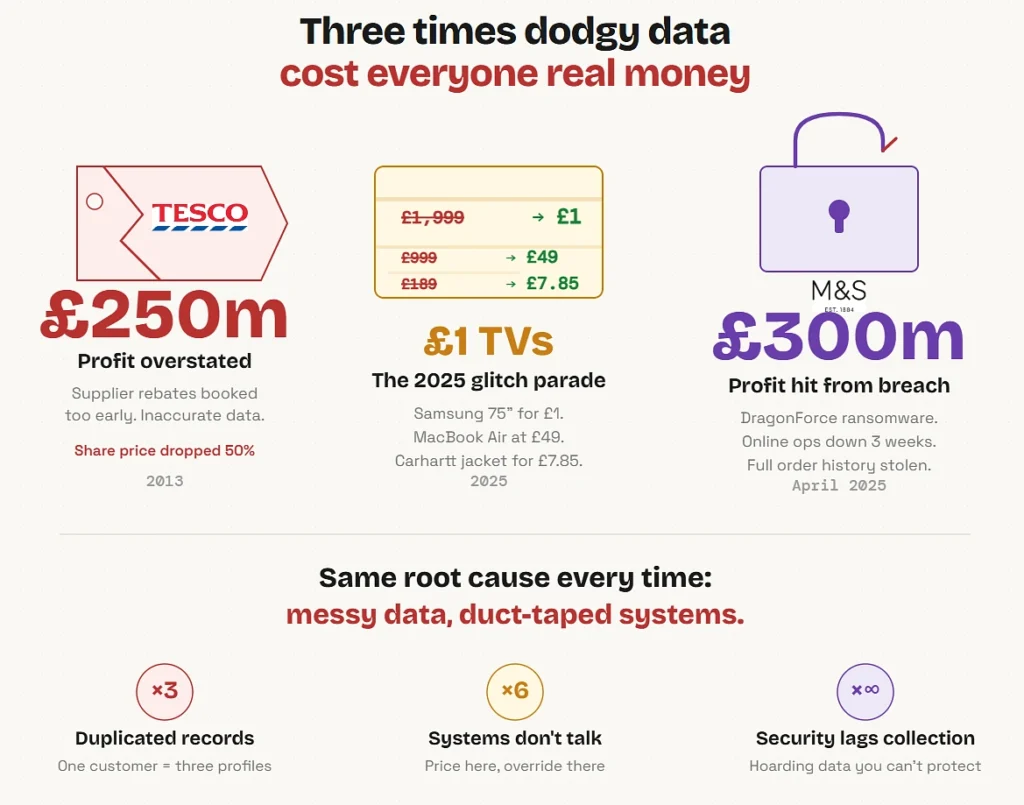
1. Tesco’s £250 Million Accounting Mess
| What happened | Tesco overstated first-half profits by £250 million in 2013 |
| Why | Supplier rebates booked too early, costs pushed into future periods — traced back to inaccurate, outdated data flowing through commercial systems |
| What it cost | Share price dropped nearly 50%. Billions wiped off market value. Store closures, job losses, years-long restructuring |
| What shoppers felt | Not direct price rises — but the financial chaos led to reduced investment, fewer stores, and a company playing catch-up for half a decade |
Supplier rebates — the deals where brands pay supermarkets for shelf space, promotions, and volume targets — are a massive part of how shelf prices get set. When the data tracking those agreements is wrong, everything downstream goes wonky. Penny wise, pound foolish doesn’t begin to cover it.
2. The 2025 Price Glitch Parade
Some of these are genuinely absurd:
- Amazon listed a Samsung 75″ Neo QLED TV (normally £1,999) for £1
- Argos priced a MacBook Air at £49.99
- A Carhartt jacket dropped to £7.85 before anyone caught it
Most lasted seconds. Some lasted long enough for people to complete orders.
These aren’t funny accidents. They’re what happens when product data, pricing rules, and promotional logic live in separate systems that don’t talk properly. A price gets entered in one place, a promotional override kicks in from another, and the website displays whatever number survives the collision.
For deal hunters who catch them? Absolute gold. For the retailers? Each glitch represents a data lake consulting problem that could’ve been prevented with proper validation rules and system reconciliation. Not exciting. But a £1 telly is pretty exciting for whoever got there first.
3. Marks & Spencer’s £300 Million Data Breach
This one isn’t funny at all.
April 2025. DragonForce ransomware hit M&S and took their entire online operation down for nearly three weeks. What got stolen:
- Customer names, addresses, emails, phone numbers
- Dates of birth
- Complete online order histories — every purchase, every search, every browsing pattern
£300 million profit impact. ICO investigation launched. The breach exposed just how much personal data retailers hoard and how vulnerable it becomes when security doesn’t keep pace with collection.
Speaking of surveillance — we’ve already written about the AI cameras, facial recognition, and gesture-detection systems now watching you in stores. But your loyalty card data is arguably more invasive than any camera. Your face walking into Sainsbury’s says you visited. Your Nectar card tells them what you bought, how often, what you almost bought, and exactly how price-sensitive you are.
What This Actually Means for Deal Hunters
If you’re reading this site, you’re already savvier than the average shopper. But even savvy shoppers don’t always clock how these systems affect them personally.
Your loyalty data shapes which deals you see. Always buy own-label? You might get nudged toward branded products with fatter margins. Shopping less frequently? Expect more aggressive discounts to reel you back. The algorithm isn’t rewarding loyalty — it’s managing your behaviour.
Your browsing data moves online prices. What you click on, how long you hover, what device you use, whether you’re a returning visitor — all of it feeds into pricing decisions. The Competition and Markets Authority investigated dynamic pricing through 2024-2025 and found it can benefit consumers, but also flagged the potential for harm when people don’t understand what’s happening.
Rejecting cookies barely scratches the surface. Device fingerprinting identifies your specific combination of browser, screen resolution, timezone, and installed fonts — recognising you across visits with 90%+ accuracy without a single cookie. The ICO started targeting the top 1,000 UK websites for dodgy tracking in 2025. Enforcement is coming, but slowly.
Data breaches weaponise your shopping habits. After the Co-op breach (also April 2025), hackers sent phishing emails that referenced customers’ actual recent purchases. “We noticed you bought baby formula last week — click here for a special offer.” When a scam knows what you had for dinner last Tuesday, spotting the fake becomes nearly impossible.
The Uncomfortable Maths of “Free” Loyalty Cards
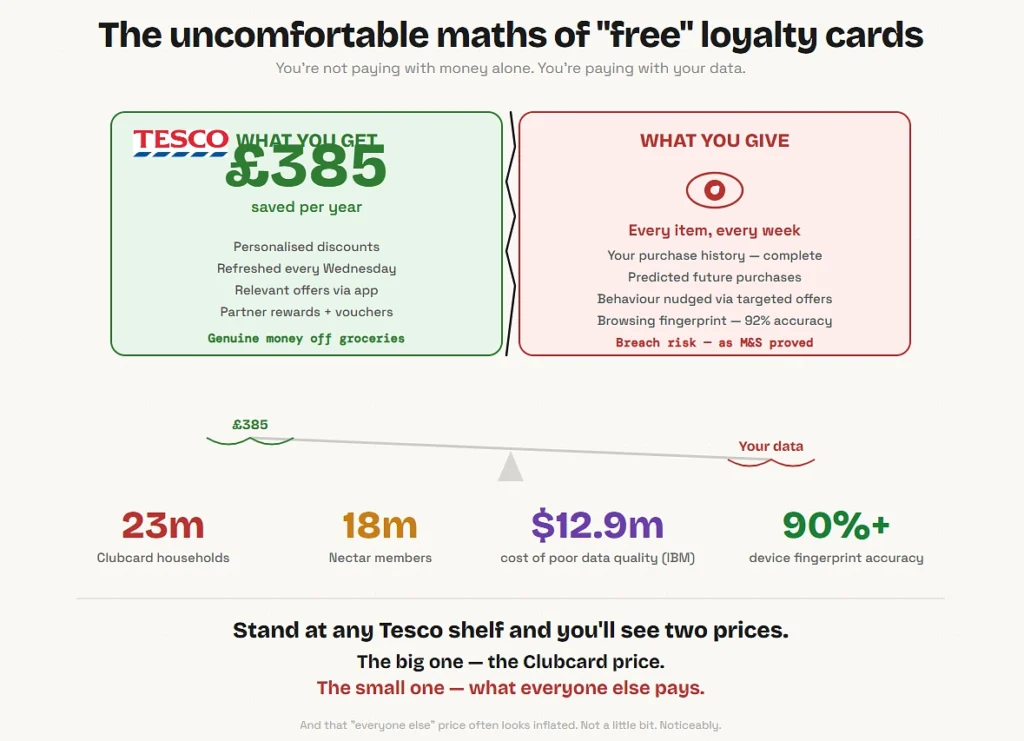
Stand at any Tesco shelf and you’ll see two prices. The big one — the Clubcard price. The small one — what everyone else pays. And that “everyone else” price often looks inflated. Not a little bit. Noticeably.
During a cost-of-living crisis, this creates a properly uncomfortable situation. People are exchanging their data — their habits, their patterns, their preferences, their entire shopping biography — for what should probably be the normal price of groceries.
“If you’re not paying for the product, you are the product.” Old internet proverb, but it hits differently when the product is a tin of baked beans.
£385 a year in Clubcard savings is genuine. That’s not nothing, especially when every penny matters. But the data you generate powers a system that:
- Tracks your habits across stores, apps, and partner businesses
- Predicts your behaviour before you’ve made a decision
- Targets you with offers designed to influence what you put in your trolley
- And — as 2025 proved multiple times — can be stolen, leaked, or misused
The retailers who manage this data properly, with clean infrastructure and strong security, genuinely deliver better deals. The ones running on messy systems, duplicated records, and duct-taped integrations produce the pricing cock-ups, the irrelevant offers, and the security holes that end up costing everyone.
Bottom Line
The data behind your discount isn’t some abstract tech issue. It’s the machinery that sets your price, decides your deals, and holds your personal information while doing both. Understanding how it works — and how often it doesn’t — is just smart shopping.
After all, forewarned is forearmed. And in a system that knows more about your weekly shop than you remember yourself, a bit of forewarning goes a long way.
Statistics referenced in this article are drawn from publicly available sources including IBM data quality research, retailer-published Clubcard/Nectar programme data, and reported breach disclosures from 2025.


