

So you’re browsing ASOS. Popup appears. “SPIN TO WIN!”
Switch to Boohoo. Another wheel. “Try your luck!”
Pretty Little Thing? Same thing. “Enter to win £500!”
Every shopping site’s running the exact same contest format now. You know why? They’re all using the same software platforms. And those platforms cost retailers anywhere from £200 to £500 monthly, depending on features and subscriber volume.
The global sweepstakes software market hit $2.1 billion in 2023. That number’s projected to reach $4.5 billion by 2028. Verified Market Research found Woobox alone reported a 50% jump in client acquisitions in February 2024. Contest software became a $1.3 billion industry in 2023, expected to hit $3.6 billion by 2032. DataIntelo tracked this across 60% of mid-to-large companies in the U.S. using some form of contest software in their 2024 marketing mix.
What Retailers Actually Get For That Money
Entry validation. The software checks if people actually followed, tagged, or shared what they claimed. No more manually sifting through thousands of entries wondering who cheated.
Automatic email collection happens the second someone enters. Every email address gets funnelled straight into MailChimp, Klaviyo, or whatever system the shop’s using.
Each email collected? Worth roughly $10-50 over the subscriber’s lifetime, according to multiple e-commerce analyses. Some estimates go lower at $0.38 to $7.01 depending on the email type and average order value. Revenue per email subscriber ranges wildly based on what you’re selling and how often you’re emailing.
Do the maths on that. Spend £300 monthly on contest software. Collect 500 emails in a month. At a conservative £10 per subscriber, that’s £5,000 in potential future value from a £300 investment.
Translation for shoppers: The contest isn’t the product. You are. That £500 prize costs them less than the email list they’re building. Though to be fair, some people do win discounts and prizes, so it’s not entirely one-sided.
The Template Economy
Software contest comes loaded with 50+ pre-made templates. Retailers aren’t getting creative. They’re picking from the same menu.
Most popular formats:
- Spin-to-win wheels (converts 10.15% of visitors on average, 12% higher than standard popups according to Wisepops data).
- Instagram photo contests.
- “Tag a friend” viral loops.
- Email-gated discount codes.
- Refer-a-friend pyramids.
Spin wheels work because of psychology. You watch that thing spin, it slows down right next to the big prize, then ticks over to “10% off.” Your brain registers that as “almost won £500” instead of “I just gave them my email for a tenner off.”
Wisepops research found gamified popups improve conversion rates by 30.3% compared to standard 3.8% popup conversion. One French retailer, Faguo, used spin-to-win and sped up lead generation 11 times while cutting costs by 75%.
People don’t ignore spinning wheels the way they ignore regular popups. It’s the gamification factor. Your brain releases a tiny hit of dopamine when you spin, even though the outcome’s predetermined.
What’s Actually Being Collected
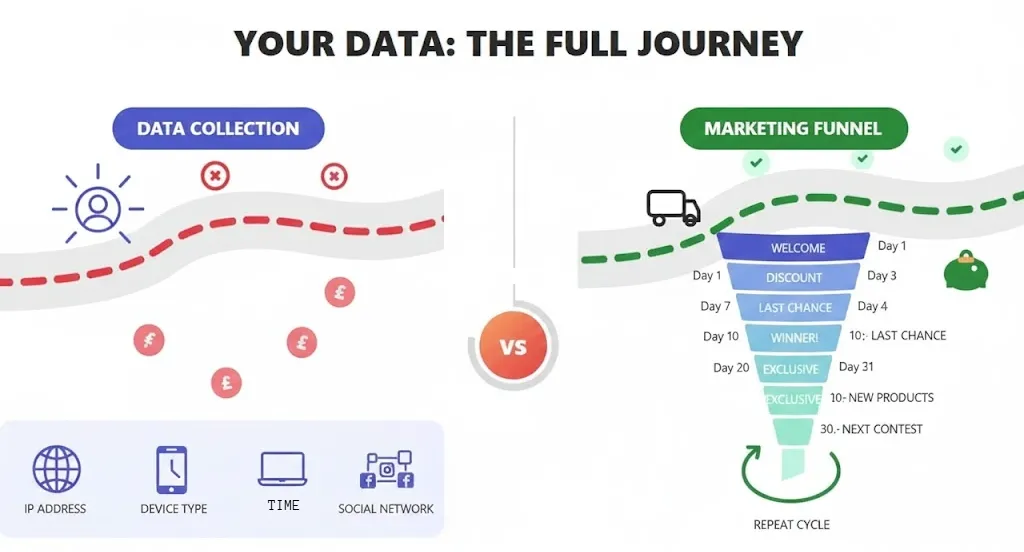
Goal one’s obvious: your email address. But it doesn’t stop there.
The software tracks everything. IP address for geolocation. Device type to know if you’re mobile or desktop. Entry timestamp showing when you’re online. Social handles if you entered via Instagram or Facebook. Friends you tagged, which maps your entire social network.
The 30-day drip sequence that follows:
- Day 1: “Thanks for entering!”.
- Day 3: “While you wait, here’s 15% off”.
- Day 7: “Contest closes soon!” (pressure).
- Day 10: “Winner announced!” (keeps you engaged even though you lost).
- Day 12: “Since you entered, you might like…” (product targeting).
- Day 20: “Exclusive offer for contest participants”.
- Day 30: “Next contest starts Monday!” (cycle repeats).
This isn’t speculation. These are standard automation sequences built into platforms like Gleam, Wishpond, and Woobox.
Secondary Goal: Social Proof
“Tag 3 friends” contests multiply exposure. Each entry creates 3 brand impressions minimum. Some contests require 5 or 10 tags.
2,000 contest entries with a “tag 3 friends” requirement equals 6,000 people seeing your brand who weren’t even looking for you. That’s 6,000 potential new customers generated from people wanting a chance at free stuff.
User-generated content sharing becomes free marketing material. Instagram photo contests where people post themselves wearing the brand’s clothing? That’s advertising the brand doesn’t have to pay for or produce.
Instagram’s algorithm rewards high engagement. More comments, tags, and shares mean the post gets shown to more people organically. Contests game the algorithm legally.
FOMO Works
28% of contest entrants browse the shop “while they’re there anyway.” Average browse-to-purchase conversion: 12% versus normal site traffic at 2%.
That’s a 6x improvement in conversion just from having people on your site for a contest. They’re already thinking about your brand. Already engaged. Already wanting something from you. Converting them costs less effort than cold traffic from ads.
Gets people back on your site before they forget about you. Most e-commerce brands fight for attention against thousands of other shops. Contests create a reason to return.
Contest Types Ranked By Actual Value To Shoppers
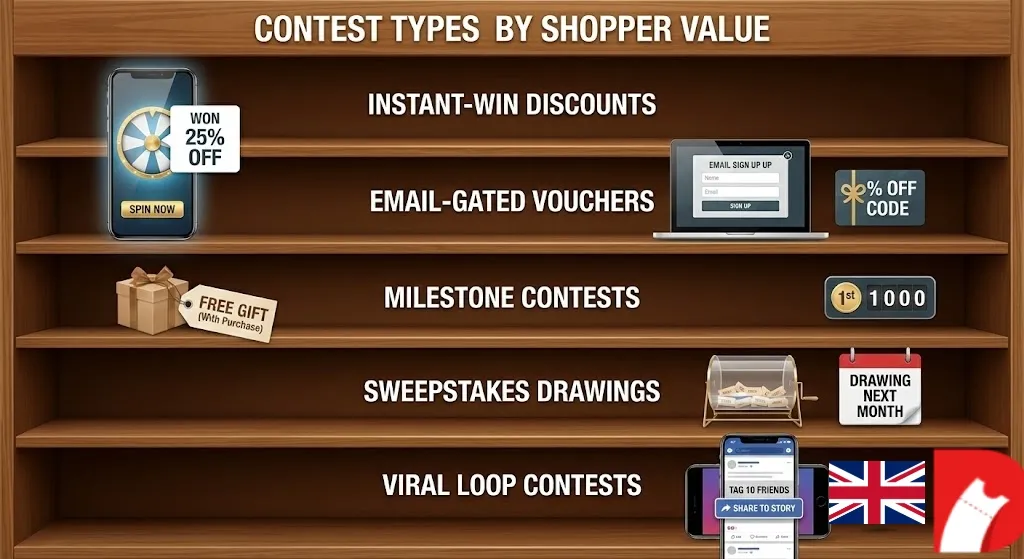
Instant-win discounts (best for you):
- Format: “Spin now, everyone wins 5-25% off”.
- Why good: Guaranteed discount immediately.
- Catch: Usually expires in 30 minutes to force impulse purchases.
- Verdict: Worth it if you were buying anyway.
Email-gated vouchers (decent trade):
- Format: “Enter email for 10% off first order”.
- Why good: Immediate value, clear exchange.
- Catch: You’re on their email list forever.
- Verdict: Use a separate shopping email address.
Milestone contests (okay odds):
- Format: “First 1,000 entrants get free gift with purchase”.
- Why okay: Higher win probability if you’re early.
- Catch: “With purchase” requirement negates the “free” part.
- Verdict: Only worthwhile if you needed the product already.
Sweepstakes drawings (poor value):
- Format: “Enter to win £1,000, drawn next month”.
- Why poor: Roughly 0.001% odds, zero immediate value.
- Catch: Pure data collection with near-zero return for entrants.
- Verdict: Skip unless entering takes under 30 seconds.
Viral loop contests (worst):
- Format: “Tag 10 friends to win!” or “Share to private story for extra entries”.
- Why worst: You’re doing their marketing for them.
- Catch: Annoying your mates for basically no chance of winning.
- Verdict: Never worth it. You’re the product, not the customer.
Smart Shopper Strategy
- Enter instant-win guaranteed discounts only if you were buying anyway. These give immediate value.
- Grab email-gated first-order codes but use a dedicated shopping email address. You’ll get spammed weekly otherwise.
- Skip sweepstakes with microscopic odds. Your time’s worth more.
- Never waste energy on viral “tag 10 friends” schemes. You’re advertising for them unpaid.
Finding proper discount codes beats gambling on contest luck. Sites like Discount Agent UK aggregate actual working codes without requiring you to spin wheels or hand over your social network. Sometimes the straightforward approach saves more money than the gamified one.
Why This Model Works

Simple answer: it works.
Prior to the development of contest software, retailers had to handle competitions manually. They had to verify each entry, pick winners, and send emails to all participants, each of which took more than the £300 required monthly.
This all changed with automation. Now, one person can create a contest and within 20 minutes, the software can do the rest. It automatically verifies and collects entries, chooses a winner, and sends emails.
They got to the point where it would actually be seen as abnormal to not run contests. Companies like Gleam and Wishpond made contest running that easy.
When COVID hit, e-commerce was one of the fastest growing industries. It’s growth was due to the ability to stand out in a market that many retailers flooded. Companies like Gleam we able to offer software that allowed retailers to easily streamline their marketing efforts and run contests.
This was necessary due to the staggering statistics. The U.S. Federal Trade Commission stated the total number of online entries to sweepstakes grew by 35 entries between the years 2020 to 2023. Data from the Pew Research Center showed 68% of U.S. adults in 2023 entered a social media contest. This was a significant increase from 55% in 2021.
Skip to the present, and it’s easy to see why retailers would automate the contest entry process. It’s easy, low cost, and with software available to streamline the process it gave retailers no reason to not grab their share of scrolling eyeballs.
What This Means For You
Every time you spin a wheel, you’re making a transaction. Your email address and social data in exchange for maybe winning something, probably winning a small discount, definitely getting marketing emails for months.
Sometimes that’s a fair trade. You wanted the discount. You were buying anyway. Getting 15% off is useful.
Sometimes it’s not. You entered for a £500 prize, got 10% off something you didn’t want, and now you’re getting emailed daily about sales you’ll never use.
The shops aren’t hiding this. They’re pretty upfront about collecting your email and using it for marketing. You have to tick a box agreeing to marketing emails in most cases. It’s legal. It’s transparent. It’s just highly optimised for their benefit, not yours.
Understanding what you’re actually trading helps you decide which contests deserve your email address and which ones you should close immediately.
Not every spinning wheel is a scam. Some provide genuine value. But knowing they’re all running the same software, using the same psychology tricks, and building the same email lists? That changes how you see those popups.
Next time one appears, you’ll know exactly what’s happening behind the scenes.


