

Buy cheap, buy twice. That old saying applies to restaurant chairs more than almost any other piece of commercial equipment, yet most buyers still fixate on the sticker price rather than what matters: the annual cost of actually owning the thing.
During my time at university, I worked as an order taker at a restaurant. I saw the owner change the same cheap chairs three times in two years. Legs snapping, backs cracking, and wobbling that made them feel bad. He thought he was saving money by getting cheap seats. He wasn’t.
A £25 plastic chair, replaced every four years, is more expensive per year than an £80 all-metal bistro chair that lasts you 18. But you’re not doing that equation at the point of purchase – hence why restaurants end up blowing thousands more than they need for a decade’s trading.
This post goes over the five basic types of commercial restaurant seating, figures out the real cost per year for each one, and explains which ones are worth the money for different types of businesses. No talk about “elevating your dining experience”—just the facts that matter to your business.
The Cost-Per-Year Formula
Before comparing chair types, understanding how to calculate true ownership cost matters more than memorising prices. This is something I wish more restaurant owners understood—it would save so much wasted money.
The formula:
Annual Cost = (Purchase Price ÷ Lifespan in Years) + Average Yearly Maintenance
A chair costing £150 that lasts 20 years with £15 annual maintenance:
- £150 ÷ 20 = £7.50 depreciation per year
- £7.50 + £15 = £22.50 total annual cost
Compare that to a £50 chair lasting 5 years with £5 annual maintenance:
- £50 ÷ 5 = £10 depreciation per year
- £10 + £5 = £15 total annual cost
The cheaper chair wins in this example. But change the lifespan or maintenance requirements and the calculation flips entirely. That’s why blanket advice about “investing in quality” misses the point—you need to run the numbers for each specific category.
The Five Restaurant Chair Categories
Commercial seating breaks down into five distinct types, each with different price points, lifespans, and maintenance profiles. Understanding these differences prevents expensive mistakes.
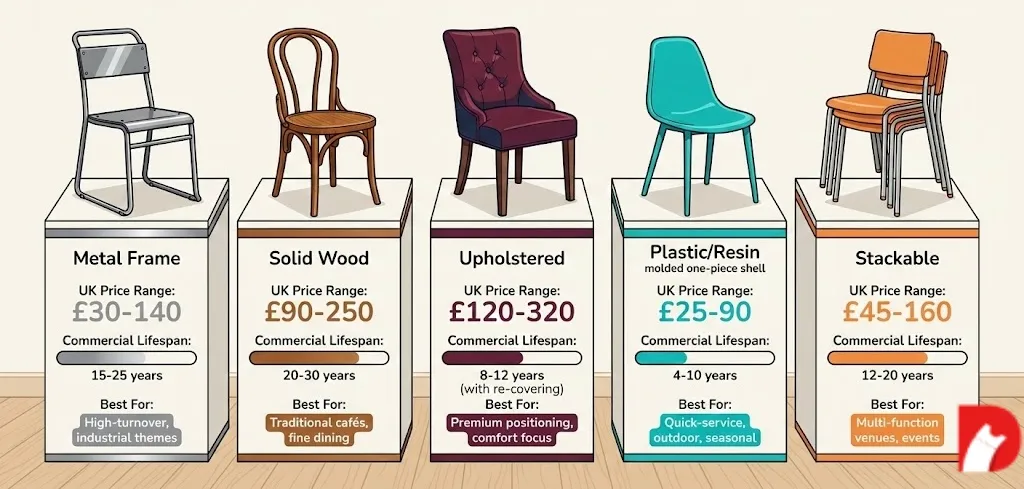
Metal Frame Restaurant Chairs
The most common type of commercial seating. Metal bistro chairs and industrial-style frames are the most common types of furniture in busy places since they are almost impossible to break when manufactured correctly.
But I’m telling you, these chairs can take a beating because I used to work in restaurants. People tug at them, kids swing from them and staff members carelessly pile them up at the end of the day. The metal chairs never broke, but the wooden ones in the corner always needed to be tightened.
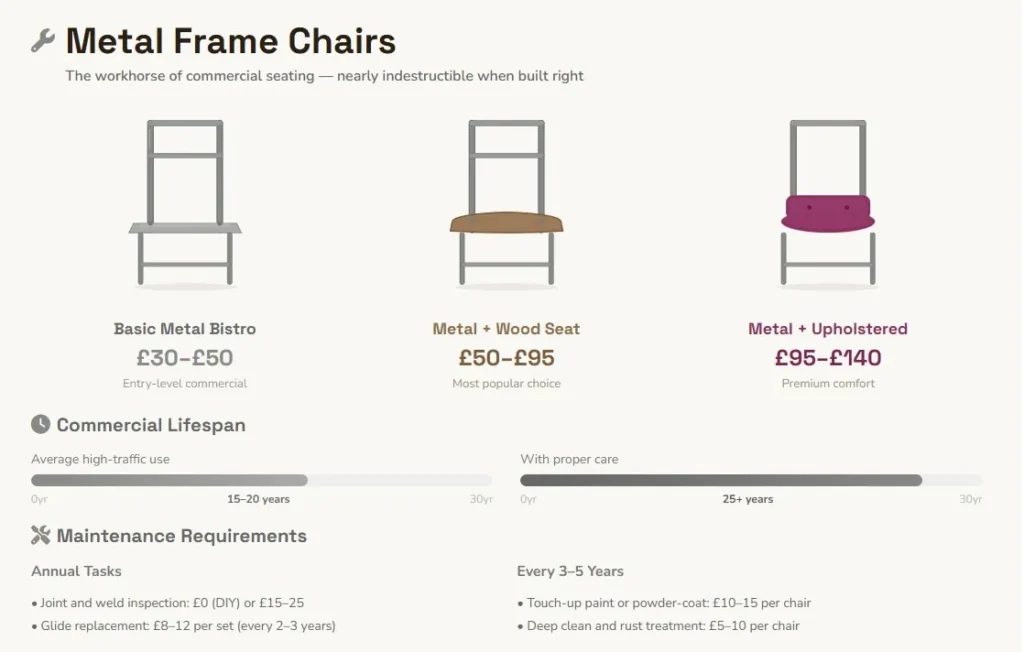
What You’re Buying
Made of steel or aluminum with a powder-coated or galvanized finish. You can choose from classic bistro styles, industrial designs, or modern minimalist frames. Some have hardwood seat pads or upholstered cushions on top of the metal frame.
Wholesale pricing from commercial suppliers typically runs 15-25% below retail for orders of 20+ units. Pack deals (usually 4 chairs) often work out cheaper per unit than singles.
Commercial Lifespan
Average: 15-20 years in high-traffic settings
With proper care: 25+ years achievable
Heavy-gauge steel (16 gauge or lower) with fully welded joints at stress points can genuinely outlast the restaurant itself. The powder-coat finish typically needs attention before the frame does.
Maintenance Requirements
Annual:
- Joint and weld inspection: £0 (DIY) or £15-25 (professional check)
- Glide replacement: £8-12 per set every 2-3 years
Every 3-5 years:
- Touch-up paint or powder-coat refinish: £10-15 per chair
- Deep clean and rust treatment: £5-10 per chair
Total average maintenance: £7-12 per year
Cost-Per-Year Calculation
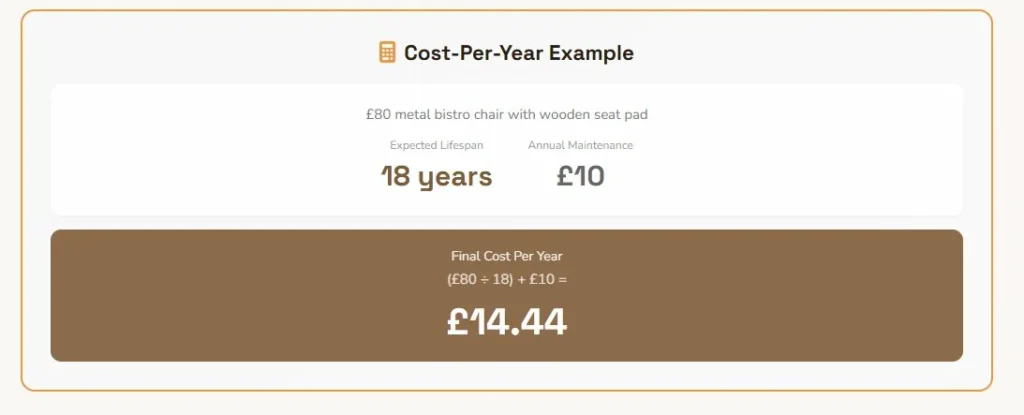
Example: £80 metal bistro chair with wooden seat pad
- Lifespan: 18 years
- Annual maintenance: £10 average
- Calculation: (£80 ÷ 18) + £10 = £14.44 per year
| Price Point | Chair Cost | Lifespan | Maintenance/Year | Cost Per Year |
| Entry (£40) | £40 | 15 years | £8 | £10.67 |
| Mid-range (£80) | £80 | 18 years | £10 | £14.44 |
| Premium (£120) | £120 | 22 years | £12 | £17.45 |
Best Use Cases
- High-turnover casual dining
- Outdoor and patio seating (aluminium especially)
- Industrial or urban-themed interiors
- Budget-conscious operations prioritising durability
- Quick-service restaurants
The Honest Assessment
Strengths:
- Lowest cost-per-year of any category
- Extreme durability in commercial settings
- Stackable options available
- Weather-resistant (aluminium and galvanised steel)
- Easy to clean and maintain
Weaknesses:
- Can feel cold or industrial
- Less padding comfort without added cushions
- Basic models look utilitarian
- Noise on hard floors (mitigated by glides)
One thing I noticed back when I was taking orders—customers rarely complained about metal chairs being uncomfortable during a 45-minute meal. The complaints came when people sat for two hours over wine and conversation. For quick casual dining, metal works perfectly. For lingering fine dining, maybe not.
Solid Wood Restaurant Chairs
The traditional choice that still dominates café and bistro settings. Solid hardwood construction offers warmth, durability, and the option to refinish rather than replace when surfaces wear.
Wooden chairs, I have a soft spot for if I’m being totally honest. The restaurant where I worked had a combination — metal to the window side for quick lunches, wooden bentwood in the back section where couples came on dinner dates. The wood simply felt warmer, more inviting. A wood-panelled section was referred to as “the nice seats in the back” — and no one realised they were even describing the wooden area.
What You’re Buying
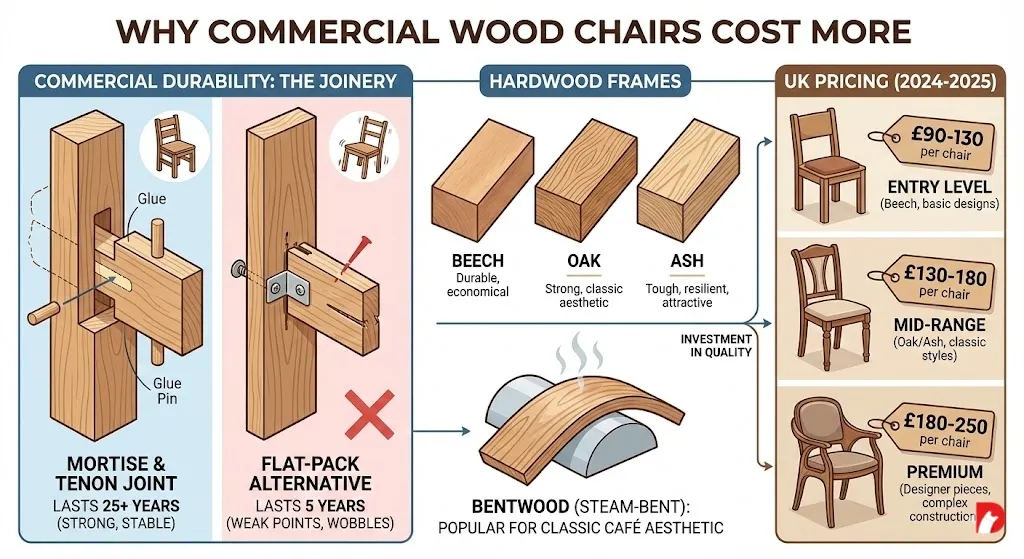
Hardwood frames—typically beech, oak, or ash—constructed with mortise and tenon joinery for commercial durability. Available with solid wood seats, upholstered seat pads, or fully upholstered backs. Bentwood chairs (steam-bent solid wood) remain popular for their classic café aesthetic.
Bentwood chairs typically sit in the mid-range at £100-160, offering good value for their classic appearance and proven durability.
Commercial Lifespan
Average: 20-25 years
Premium hardwoods with proper maintenance: 30+ years
The longevity depends heavily on construction quality. Mortise and tenon joints with glued and screwed reinforcement outlast dowel or screw-only construction by years. Commercial-grade chairs use 1-inch thick solid wood seats rather than veneered particle board.
Maintenance Requirements
Annual:
- Joint tightening and inspection: £0 (DIY) or £20-30 (professional)
- Wax or oil application: £3-5 per chair
Every 5-7 years:
- Refinishing (sand and re-stain): £25-40 per chair
- Professional repair of loose joints: £15-25 per chair
If seat is upholstered (every 8-10 years):
- Seat pad reupholstery: £40-80 per chair
Total average maintenance: £15-25 per year (all-wood) or £20-35 per year (with upholstered seat)
Cost-Per-Year Calculation
Example A: £150 all-wood chair
- Lifespan: 22 years
- Annual maintenance: £20 average
- Calculation: (£150 ÷ 22) + £20 = £26.82 per year
Example B: £150 wood chair with upholstered seat pad
- Lifespan: 22 years
- Annual maintenance: £25 average (including periodic reupholstery)
- Calculation: (£150 ÷ 22) + £25 = £31.82 per year
Best Use Cases
- Traditional restaurants and cafés
- Establishments prioritising warm, inviting atmosphere
- Fine dining (with upholstery)
- Heritage or classic interior themes
- Venues where refinishing is preferable to replacement
The Honest Assessment
Strengths:
- Long lifespan with proper care
- Classic aesthetic that doesn’t date
- Repairable and refinishable rather than disposable
- Warm appearance and feel
- Available in numerous styles and finishes
Weaknesses:
- Higher upfront cost than metal or plastic
- Heavier to move and rearrange
- Requires more ongoing maintenance
- Susceptible to moisture damage if finish fails
- Joint loosening over time (normal but needs attention)
Upholstered Restaurant Chairs
The comfort-first option that commands higher maintenance costs but creates premium dining atmospheres where customers linger and spend more.
What You’re Buying
Padded seats and backs covered in fabric, vinyl, or leather, mounted on wood or metal frames. Ranges from simple seat-pad cushioning to fully upholstered designs where no frame is visible. Commercial-grade upholstery uses high-density foam and fabrics rated for heavy use (15,000+ double-rub count).
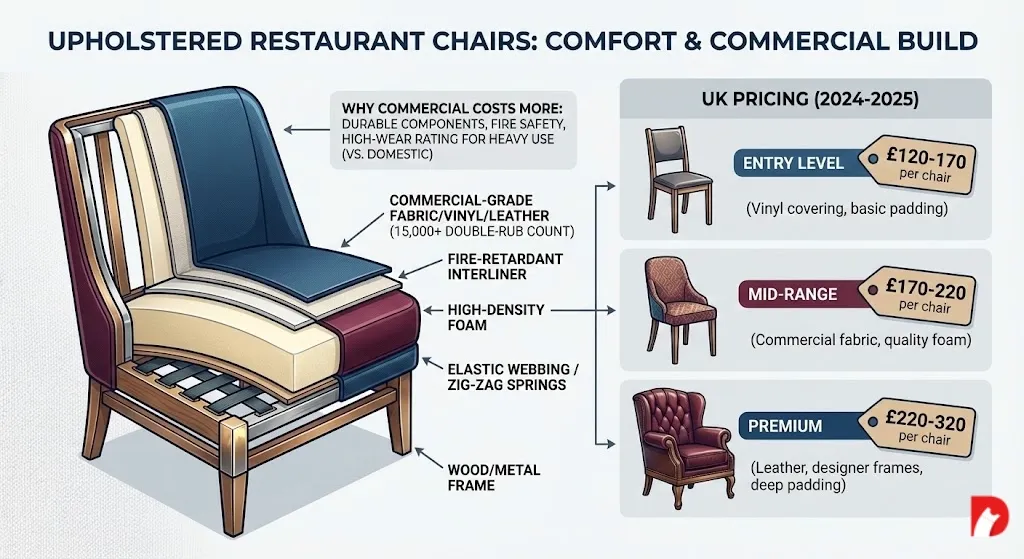
Fire safety compliance adds cost. UK regulations require commercial upholstered seating to meet BS 7176:2007 standards, with CMHR (Combustion Modified High Resilient) foam mandatory for medium-hazard venues like restaurants.
Commercial Lifespan
Frame lifespan: 15-20 years
Upholstery lifespan: 5-8 years before recovering needed
Effective overall lifespan: 10-15 years (accounting for 1-2 recoverings before frame replacement makes more sense)
The frame outlasts the covering, which is why reupholstery services exist. But after two or three recoverings, the economics often favour replacement, especially if the frame shows wear or the style has dated.
Maintenance Requirements
Monthly:
- Professional steam cleaning: £8-12 per chair (essential in food service)
- Spot cleaning between deep cleans: included in regular staff duties
Annual:
- Frame inspection and tightening: £0-20
- Stain treatment and fabric protection: £5-10 per chair
Every 6-8 years:
- Full reupholstery: £40-100 per chair (seat only: £40-60, seat and back: £80-100)
Total average maintenance: £100-150 per year
The cleaning costs dominate. Monthly professional steam cleaning at £10 per chair runs £120 annually before any other maintenance. This is non-negotiable in food service—skipping it creates hygiene issues and accelerates fabric degradation.
I saw this firsthand. The upholstered booth seating at my old workplace needed constant attention. Spilled wine, sauce drips, kids with sticky fingers—the fabric absorbed everything. The owner eventually switched the family section to wipe-clean vinyl because the cleaning bills were eating into margins. My opinion? Unless you’re running a proper fine dining operation where the bill covers the overhead, think twice about fabric upholstery in high-traffic areas.
Cost-Per-Year Calculation
Example: £180 upholstered chair (wood frame, fabric covering)
- Effective lifespan: 12 years (including one reupholstery)
- Annual maintenance: £130 average (dominated by cleaning)
- Calculation: (£180 ÷ 12) + £130 = £145 per year
CONSIDER CREATING VISUAL FOR BELOW DATA – UPHOLSTERED MAINTENANCE BREAKDOWN
| Maintenance Item | Frequency | Cost Per Chair | Annual Equivalent |
| Steam cleaning | Monthly | £10 | £120 |
| Fabric protection | Yearly | £8 | £8 |
| Frame inspection | Yearly | £10 | £10 |
| Reupholstery | Every 7 years | £70 | £10 |
| Total | £148/year |
Best Use Cases
- Fine dining restaurants
- Low-turnover establishments where comfort extends dwell time
- Premium positioning where atmosphere justifies higher costs
- Venues where customers pay enough to absorb seating costs
- Sound-sensitive spaces (upholstery absorbs noise)
The Honest Assessment
Strengths:
- Superior customer comfort
- Premium appearance and atmosphere
- Sound absorption (quieter dining rooms)
- Wide range of fabric colours and textures
- Can transform basic frames into statement pieces
Weaknesses:
- Highest cost-per-year by significant margin
- Intensive cleaning requirements
- Stain vulnerability (especially fabric)
- Shorter effective lifespan than hard-surface chairs
- Fire safety compliance adds complexity
Plastic and Resin Restaurant Chairs
The quick-service standard and outdoor workhorse. Low upfront cost and minimal maintenance make plastic chairs viable for high-volume, low-margin operations where durability matters less than replaceability.
What You’re Buying
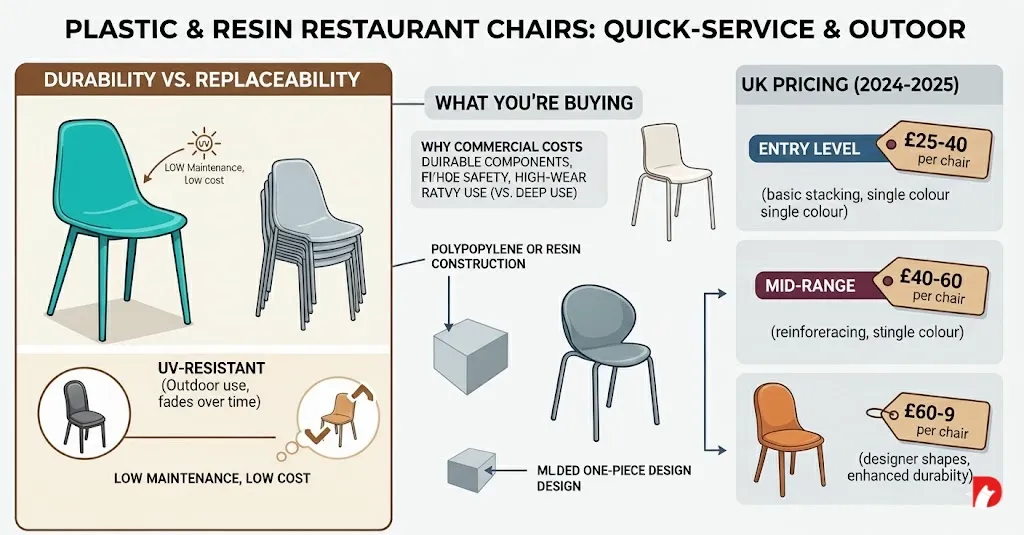
Polypropylene or resin construction, usually moulded as one piece or with minimal assembly. Available in basic stacking designs through to more sculptural modern shapes. UV-resistant formulations exist for outdoor use, though degradation still occurs over time.
Plastic folding chairs are at the lowest end of that range — about £15-30 — but are not appropriate for daily restaurant use. Folding chairs don’t require such reinforcements, but commercial polypropylene chairs do.
Commercial Lifespan
- Indoor use: 6-10 years
- Outdoor use: 5-8 years (UV degradation accelerates wear)
- High-traffic quick-service: 4-6 years
Plastic chair doesn’t often get’s repaired (considered disposable, they can be repaired if the break is not catastrophic). When legs crack, surfaces scratch beyond acceptability, or fading makes chairs look shabby, replacement is the only option. This “disposable” nature is factored into the economics—you’re essentially renting rather than owning.
Maintenance Requirements
Regular:
- Cleaning: £0 (simple wipe-down, included in regular operations)
Annual (outdoor chairs):
- UV protection spray: £5-8 per chair
As needed:
- Glide/foot replacement: £3-5 per chair
Total average maintenance: £5-10 per year
The minimal maintenance is plastic’s main advantage. No refinishing, no reupholstery, no professional servicing. Wipe down, replace glides occasionally, dispose when worn.
Cost-Per-Year Calculation
Example A: £50 plastic chair (indoor use)
- Lifespan: 7 years
- Annual maintenance: £5
- Calculation: (£50 ÷ 7) + £5 = £12.14 per year
Example B: £50 plastic chair (outdoor use)
- Lifespan: 6 years
- Annual maintenance: £8
- Calculation: (£50 ÷ 6) + £8 = £16.33 per year
Best Use Cases
- Quick-service and fast-casual restaurants
- Outdoor and patio seating
- High-volume, low-margin operations
- Temporary or seasonal venues
- Children’s areas (easy to clean, lightweight)
I’ll be straight with you—plastic chairs get a bad reputation, but they serve a purpose. When I see a chicken shop or kebab house with plastic seating, I don’t think “cheap owner.” I think “sensible owner who knows their business model.” Nobody expects plush leather when they’re grabbing a £6 meal at midnight. Match the seating to the service, not to some aspirational image of what you wish the restaurant was.
The Honest Assessment
Strengths:
- Low upfront cost
- Minimal maintenance requirements
- Lightweight and easy to move
- Weather resistant
- Simple to clean
Weaknesses:
- Shortest lifespan of any category
- Not repairable—replacement only
- Can appear cheap or basic
- Environmental concerns with disposal
- Colour fading (especially outdoors)
Stackable Restaurant Chairs
The flexibility option for venues that need to reconfigure spaces regularly. Available in metal, wood, and plastic variants, with the “stackable” designation adding specific design considerations.
What You’re Buying
Chairs designed to stack 8-12 high without damage, with reinforced stack points and balanced weight distribution. The stacking capability requires specific frame geometry—not every chair style adapts well.
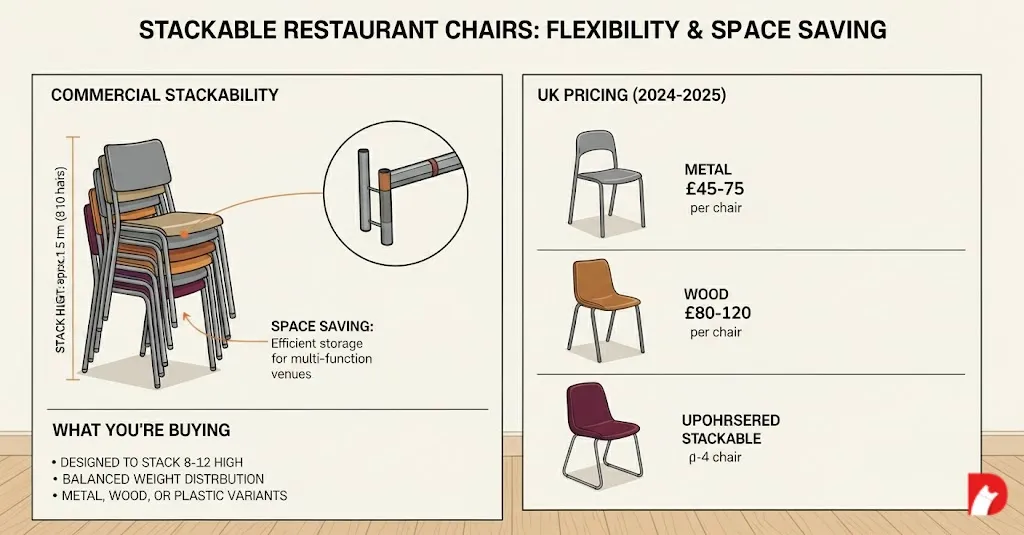
The “stackable” feature adds roughly 10-15% to equivalent non-stacking designs due to reinforcement requirements and engineering for repeated stacking stress.
Commercial Lifespan
Metal stackable: 12-18 years
Wood stackable: 15-20 years
Lifespan reduces compared to non-stacking equivalents because the stacking action creates wear points. How frequently chairs are stacked matters significantly—daily stacking shortens lifespan more than occasional rearrangement.
Maintenance Requirements
Every 6 months:
- Stack point inspection: £0 (DIY visual check)
- Tightening from stacking stress: £0-10
Every 2 years:
- Stack pad replacement: £8-12 per chair
- Wear point assessment: included in regular inspection
Plus base material maintenance:
- Metal: same as standard metal chairs
- Wood: same as standard wood chairs
- Upholstered: same as standard upholstered chairs
Total average maintenance: £10-15 per year (metal) to £25-35 per year (upholstered)
Cost-Per-Year Calculation
Example: £65 metal stackable chair
- Lifespan: 15 years
- Annual maintenance: £12
- Calculation: (£65 ÷ 15) + £12 = £16.33 per year
Best Use Cases
- Multi-function venues (dining + events)
- Banquet halls and conference spaces
- Restaurants with variable seating needs
- Seasonal overflow capacity
- Storage-constrained operations
The place I worked did private functions on Sunday evenings—christenings, small birthday parties, that sort of thing. We’d stack half the regular chairs in the back room and rearrange tables for the event. Without stackable seating, it would have taken twice as long to set up and we’d have needed a separate storage unit. The flexibility genuinely pays for itself if you use it.
The Honest Assessment
Strengths:
- Space efficiency when stored
- Flexibility for layout changes
- Available in all material types
- Enables multi-use revenue from same space
Weaknesses:
- Stack wear reduces lifespan
- More expensive than non-stacking equivalents
- Stack height limits (typically 8-12 max)
- Some styles don’t stack attractively
The Complete Cost-Per-Year Comparison
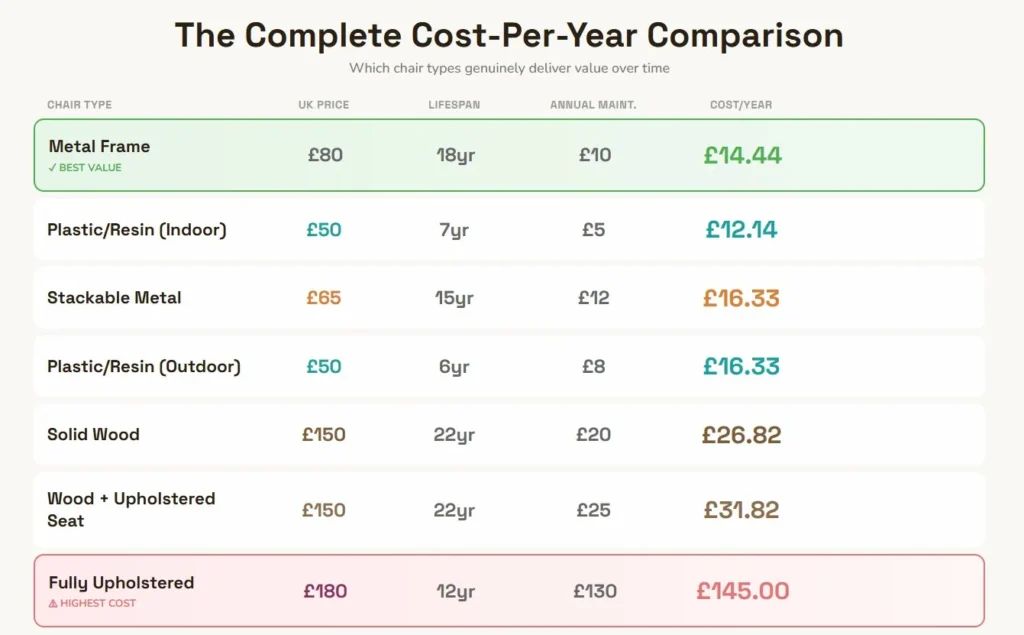
Running the numbers across all five categories reveals which chair types genuinely deliver value over time.
What the Numbers Show
- Lowest cost-per-year: Plastic indoor chairs at £12.14, but they need replacing every 7 years and look basic.
- Best balance of value and durability: Metal frame chairs at £14.44 per year with 18-year lifespan.
- The hidden expense: Upholstered chairs cost nearly 10x more annually than metal once cleaning is factored in. This was the biggest surprise to me when I first ran these numbers—I knew upholstery needed more care, but I didn’t expect the gap to be this massive.
Flexibility premium: Stackable chairs cost roughly £2-4 more per year than non-stacking equivalents—worth it if you actually use the flexibility.
Matching Chair Type to Business Model
The “best” restaurant chair doesn’t exist universally. Different business models have different requirements.
High-Turnover Casual Dining
Recommended: Metal frame chairs (£14-17/year)
Durability matters more than comfort when average table time is under 45 minutes. Metal withstands constant use, cleans easily, and survives the inevitable mishandling that comes with high volume. The cost-per-year advantage compounds over a decade of trading.
Fine Dining
Recommended: Upholstered or high-end wood (£30-145/year)
When the punters are paying £80+ per head, the cost of providing the seating is nothing compared to what they’re making. Comfort adds to dwell-time and yields the experience that premium pricing demands. That £145-a-year upholstered chair actually earns more money than it costs if it makes just one extra customer stay for dessert and coffee.
I watched this happen, I remember that. Sated guests order another bottle of wine. They stay for pudding. They haven’t got to stand up because the chair’s killing their back. From experience seating pays back from the extra covers and increased average check comfort provides.
Quick-Service Restaurants
Recommended: Plastic or basic metal (£12-16/year)
Margins are tight, turnover is everything, and nobody expects plush seating with their £8 lunch. Plastic’s low cost and easy cleaning suit the operational model. Replace every 5-7 years without sentiment.
Café or Bistro
Recommended: Solid wood or bentwood (£25-32/year)
Aesthetic.But one thing can be known for sure, Bentwood chairs have shaped café culture for longer time because of their mixture of warmth, durability and style.Worth the maintenance in return for the environment they help bring about.There is an impossible-to-pinpoint something about a bentwood chair that just says “real café.”
I can’t tell you why, but people respond to it. The place where I worked was not fancy, but those wood seats in the back part made customers there feel as if they were in some place worth being in. That kind of perception affects how much they order, how long they stay and whether return later on. Do not underestimate what your seats are telling would-be patrons of establishment quality.
Multi-Function Venues
Recommended: Stackable metal (£16/year)
The space flexibility premium pays for itself if you’re hosting events alongside regular service. Being able to clear a dining room for private functions doubles the revenue potential from the same square footage.
Outdoor Seating
Recommended: Aluminium metal or UV-resistant plastic (£14-17/year)
Weather resistance isn’t optional. Aluminium won’t rust; quality plastic resists UV degradation longer than cheap alternatives. Factor 5-8 year outdoor lifespans into calculations regardless of material choice.
Buying Considerations
Where to Source
Commercial furniture suppliers (not retail home furnishing stores) offer chairs built for heavy use. The difference matters—domestic chairs rated for occasional use fail quickly in commercial settings.
One mistake I watched happen: the owner bought “dining chairs” from a home furniture shop because they looked nice and cost less than the commercial equivalents. Within six months, the joints were loose on half of them. Domestic furniture isn’t built for eight hours of daily use by different people of varying weights. Commercial-grade exists for a reason.
UK commercial suppliers typically offer:
- Bulk pricing (10-20% discount on 20+ units)
- Commercial-grade warranties (5-10 years on frames)
- Replacement part availability
- Fire safety compliance certification
What to Check Before Purchase
For metal chairs:
- Steel gauge (16 gauge or lower for durability)
- Weld quality at stress points
- Powder-coat thickness and finish quality
- Weight capacity rating (500lb+ for commercial use)
For wood chairs:
- Mortise and tenon joinery (not dowels or screws alone)
- Solid hardwood vs veneered construction
- 1-inch minimum seat thickness
- Metal reinforcement at high-stress joints
For upholstered chairs:
- Double-rub count (15,000+ for commercial grade)
- Foam density and resilience rating
- Fire safety certification (BS 7176:2007)
- Removable covers vs fixed upholstery (affects cleaning)
For plastic chairs:
- Reinforced legs and base
- UV resistance rating (for outdoor use)
- Weight capacity
- Glide/foot replaceability
Warranty Considerations
Commercial chair warranties typically cover:
- Frame defects: 5-10 years
- Welds and joints: 5-10 years
- Finish: 1-3 years
- Upholstery: 1-2 years (fabric) or 3-5 years (frame under fabric)
Extended warranties rarely make financial sense given the long lifespans of quality commercial chairs. A 10-year frame warranty on a chair with 18-year expected lifespan covers the period where manufacturing defects would appear anyway.
The Bottom Line
Regardless, the lowest-end seat is not the best deal. The most expensive chair is not necessarily the best investment. Ultimately, it’s how that cost-per-year works out with the model you operate on, and the chair helps you save over its full life.
Metal frame chairs are a clear winner for sheer economic value at £14-17 per year and very little in the way of bother. Upholstered chairs cost ten times as much per year but make perfect sense when revenue is driven by comfort. In the middle are wooden chairs, which bring warmth and durability at a reasonable ongoing cost.
When I think back on my time waiting tables, it’s all I can wish for: That the owner would have done that math prior to purchasing. Would have saved him hassle, me the embarrassment of apologising to customers for wobbly seats, and the business thousands over that year I worked there.
Run the numbers before buying. Calculate actual cost-per-year using the formula, factor in your specific maintenance capabilities, and match the chair type to how your business actually operates.
A 50-seat restaurant opts for metal rather than upholstered chairs and saves about £6,500 per year in total owner ship costs (50 chairs × a difference of £130). That’s £65,000 over 10 years — enough to make a meaningful difference to any operation’s bottom line.
The maths doesn’t lie. Do the math, make the decision that best suits your business and stop overpaying for seats that are doing the same thing.


