

It is a weird phenomenon when you purchase real estate. You’re going to give over more money than you have ever paid out of money– more than you have ever paid out of money– and you are bargaining single-handed and in most countries, to the bargain.
The seller possesses an agent. Such an agent earns a commission to fetch the best price. It is their commission. And over the other side of the table? In Britain there is thee. Perhaps a lawyer doing some documents. But none whose business is to see to it that you do not overpay.
Not everywhere it is like this. It is now a common practice in competitive markets in Australia to hire someone to represent you as a buyer. The buyer agents in America have been in existence since decades, but the regulations regarding the payers have flipped over. All systems have trade-offs, and the knowledge of them may alter your approach to the next property purchase.
The British Way: You’re On Your Own
This is the way it works in the UK. The seller contracts and remunerates the estate agent. They are employed to sell the property, make viewings, and negotiate offers all on behalf of the seller. When they so happen to be friendly and helpful to you as a buyer do remember: that their commission is on the sale being made off at the most advantageous price to their client. That’s not you.
The commission paid by the estate agent is usually 0.75-3% of the selling price including VAT. On a £400,000 house, that’s potentially £12,000 or more. Yes, paid by the seller. But into the price you pay you are.
You do not actually pay the estate agent as a buyer. Nor does it have anyone that is working directly on your behalf at the negotiation. The legal part is done by your solicitor or conveyancer, who does searches, contracts, completion, but does not tell you whether you are paying too much, or whether there is a lot of room to negotiate.
The expectation ingrained in British property culture is that purchasers are able to take care of themselves. Do your homework, Rightmove, perhaps have a survey, and follow your intuition. This is okay in simple purchases in less active markets. However, in competitive scenarios, such as sealed bids, gazumping, the pressure of an auction, you are taking a notepad to a knife fight.
The American System: Everyone Has an Agent (Sort Of)
Cross the Atlantic and the picture changes. In the US, buyer’s agents have been the norm for decades. You get your own agent, they show you properties, they negotiate on your behalf, and — here’s the bit that always seemed too good to be true — the seller pays their commission too.
The typical American model used sellers to pay a commission of 5-6% of the entire sale to the listing agent and the buyer agent. All are represented, no one on the buying side is out of pocket. Win-win, surely?
Not quite. That was always built into the sales price. It was being paid by buyers as more expensive property costs- they just did not see a separate line item. And critics claimed that the system was a perverse incentive. Are you paying your agent more and get paid more; whose interests are they addressing?
In March 2024, the National Association of Realtors settled a lawsuit by agreeing to pay a $418 million settlement after a jury ruled they had conspired to inflate commissions. With the new rules, which will be in effect as of August 2024, everything is different. The MLS listings no longer require sellers to pay commission to the agents of buyer. Customers must now make written contracts with their agents prior to seeing homes, clearly specifying compensation terms.
The initial statistics at Redfin indicate that commissions are not declining significantly yet, about 2.3-2.4% on buyer agents and the difference between the two settlement is insignificant. However, the transparency is novel. Even though the amount may not have changed, American buyers are fully aware of what they are paying their agent.
The unintended consequence? First-time buyers and those in lower-priced markets may struggle most. If you’re buying a $200,000 starter home and need to pay your agent’s commission yourself, that’s potentially $5,000 extra at closing. The “free” representation was never free, but at least it was invisible.
The Australian Approach: Pay Your Own Advocate
Australia took a different path entirely. Buyer’s agents — called buyer’s advocates — have grown into a proper industry, particularly in high-competition markets like Sydney and Melbourne. And unlike the old American system, there’s no ambiguity about who’s paying: you are.
The model is simple. You employ somebody to work on your behalf. They scan and find properties (even off-market ones which are not seen by anyone), they compare them to similar sales, they even visit the inspections on your behalf, and bid at the auction, and negotiate the purchase. Their loyalty is without division since their fee is based on you and not the transaction.
How much is this? In Melbourne, the fee charged by buyer agents is between 1.5 and 2.75 percent of the purchase price, or between 5,000 to 20,000 fixed fee in accordance with the service level. For a $900,000 property at 2%, that’s $18,000. Not pocket change.
And here is the calculation that Australian buyers make: when a negotiator of abilities can save you 30,000 in a house which would otherwise have sold at 930,000 you are in the money. The charge is self-rewards. And in markets where there are auctions, and off-market are the making, it is important to know the game.
The industry has professionalised significantly. Services marketed as top rated Melbourne buyers agents now operate with formal credentials, industry associations, and client reviews. It’s become a normal part of the property landscape rather than a luxury for the wealthy.
For investment buyers, there’s a tax angle too — the buyer’s agent fee often forms part of the cost base, reducing capital gains tax when you eventually sell.
What Each System Actually Costs You
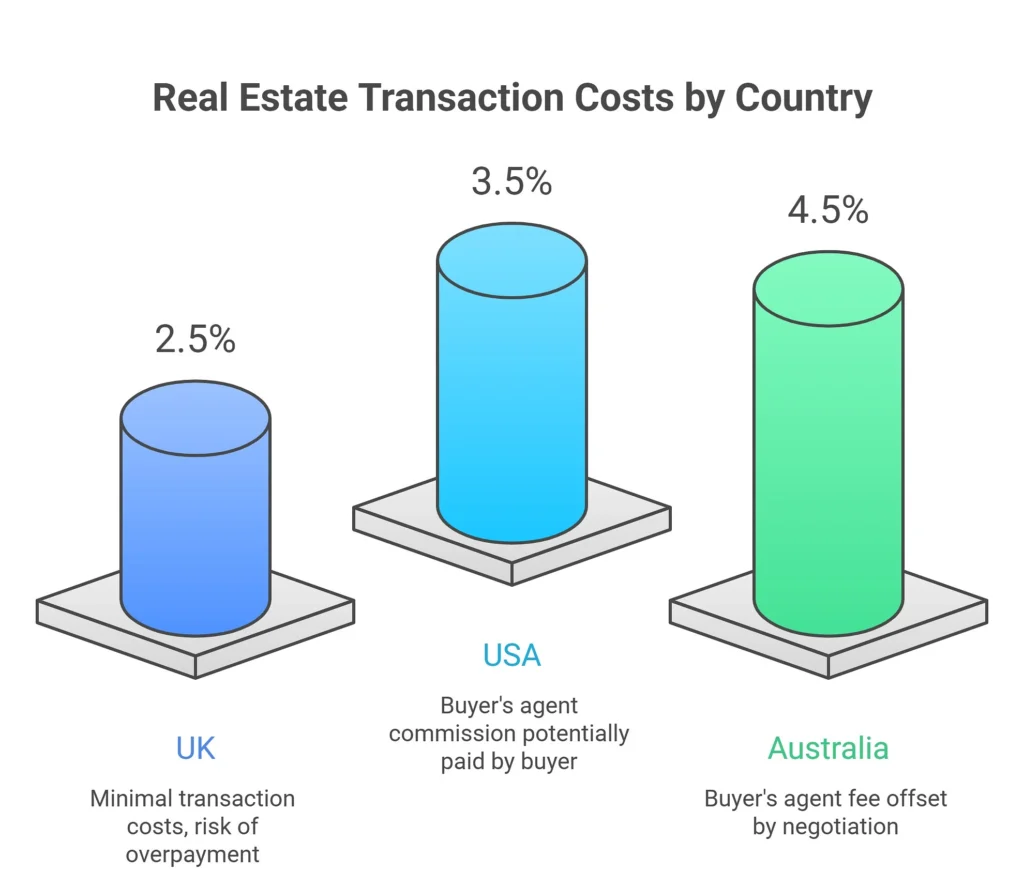
Let’s put real numbers on this. Same property value, different systems.
Property price: £500,000 / $650,000 USD / $900,000 AUD
UK buyer:
- Estate agent fee: £0 (paid by seller).
- Your representation: £0.
- Legal/conveyancing: £1,500-2,500.
- Surveys: £500-1,500.
- Potential overpayment from weak negotiation: Unknown, but studies suggest 5-10% above fair value is common for inexperienced buyers.
US buyer (post-2024 settlement):
- Buyer’s agent commission: 2-3% ($13,000-19,500), potentially paid by you.
- Legal fees vary by state.
- Closing costs: 2-5% additional.
Australian buyer (using buyer’s advocate):
- Buyer’s agent fee: 1.5-2.5% ($13,500-22,500).
- Conveyancing: $1,500-3,000.
- Building/pest inspection: $500-800.
The Australian approach looks expensive until you factor in what you’re getting: someone whose entire job is making sure you don’t overpay. If they’re good at their job, the fee disappears into the savings.
The Hidden Cost of No Representation
This is what does not feature in all those calculations: the deals you never heard about, the price cut you never leveraged, the warning bells that you overlooked because no one was watching out to you.
The information asymmetry is clear in British property transactions. The estate agent is aware of other offers being made. They are aware of the level of motivation of the seller. They are aware of the history of the property, the unsuccessful sales, the survey problems of the preceding attempts. You can know what they would like to say to you.
Seasoned shoppers are instinctive. They know how to read between the lines, to push back, to walk away. Most citizens are one time buyers of property. You are an amateur who is negotiating with professionals. There is a cost to that split, though you may never see it on a receipt.
The Australian model is not flawless – you are still buying an expertise and not every buyer agent is equally valuable. At least the incentives are the same. When the guy representing you only gets a commission when you go out and purchase and their reputation is to get you a good deal, you are pulling in the same direction.
What British Buyers Could Consider
The UK doesn’t have a strong buyer’s agent culture, but it’s starting to emerge. A handful of firms now offer property search and negotiation services, particularly in London and the South East. Fees vary, but the concept is the same: pay someone to represent your interests, not the seller’s.
To the majority of British purchasers, however, the sage advice is more straightforward: realize that no one at the table is employed on your behalf, and behave as such.
Take your own survey– a good one, not a mortgage valuation. Compare similar sales on their own. Do not take the price that the estate agent recommends as a limit. Be tougher than polite to negotiate, since the agent has to get as much as possible out of you.
And when you are making a purchase in a competitive environment, like an auction, or sealed bids or multiple interested parties, think about whether the stakes are high enough to warrant the help. Professional representation may be the most significant investment of hundreds of thousands of pounds.
The Point Isn’t Which System is Best
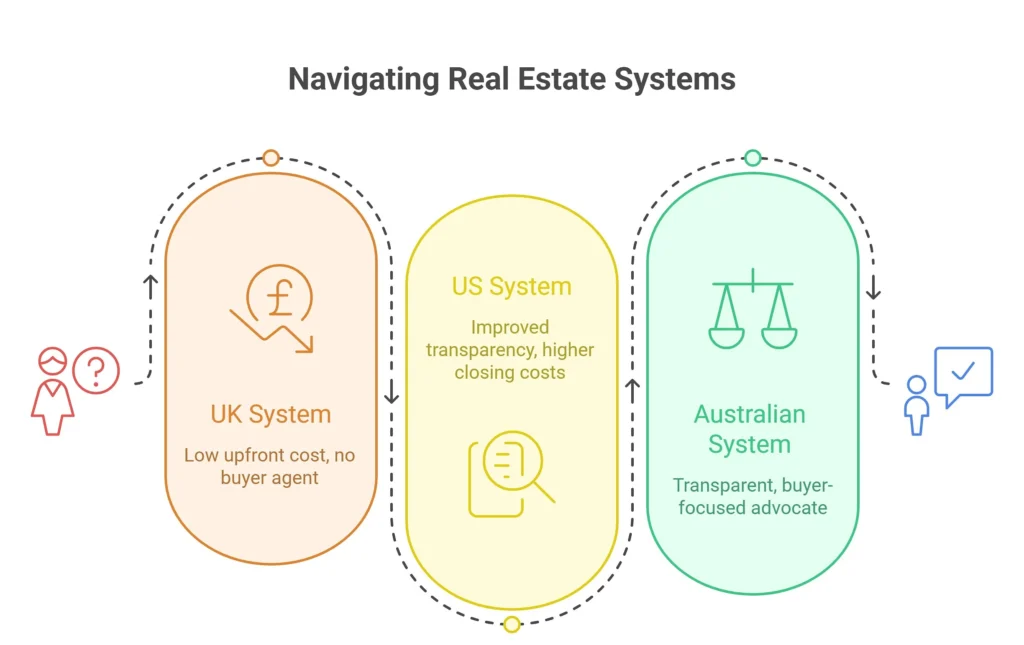
Every approach has trade-offs. The British system keeps costs low but leaves buyers exposed. The old American model provided universal representation but hid the true cost in inflated prices. The Australian approach is transparent and aligned, but you’re writing a cheque upfront.
What matters is understanding who’s actually in your corner. When you’re negotiating the biggest purchase of your life, “nobody” is a worse answer than you might think.
The money you save by not hiring representation isn’t saved if you overpay by more than the fee would have cost. And if you’ve never negotiated a property deal before, going up against someone who does it daily isn’t a fair fight.
Whatever system you’re buying in, the question is the same: who benefits when this deal closes, and are your interests on that list?
Property processes and fees vary by region and change over time. US commission rules reflect the August 2024 NAR settlement. Australian buyer’s agent fees based on 2025-2026 market data. Always verify current requirements with local professionals before making property decisions.


