

When you place an order online you anticipate that it will be delivered at the time the retailer invites. According to the recent data published by Ofcom, a lot of people have not been finding the reality on par with expectation. The delivery networks in the UK had hit a low of 83 percent during the 2024 peak season with regard to the arrival of parcels on time. The performance of Royal Mail was worse since first-class mail was only delivering 76.5% on-time against the 93% regulatory target.
Those are not disappointing statistics. Delayed deliveries cost you money in places that are not written on your bill.
What Actually Causes Delivery Failures
- Poor route planning sends drivers zigzagging across entire cities instead of following logical geographical patterns. A driver might deliver to your street, then travel five miles away, then come back to your neighbourhood for another drop. This wastes fuel, creates delays, and means your parcel sits in the van longer than necessary.
- The absence of real-time updates leaves you guessing about when to expect your delivery. Traditional courier systems often give you a window spanning four to eight hours, or worse, just say “sometime today.” Without knowing where the driver actually is, you can’t run quick errands or step out for anything, so you’re stuck at home the entire day.
- Delivery window inflexibility causes problems when your work schedule or personal commitments clash with whatever arrival time the retailer selected for you. If the delivery slot is Tuesday between 9am and 5pm and you work those exact hours, you’re forced to take time off or miss the delivery entirely.
- Weather and traffic not being factored into delivery schedules means drivers follow predetermined routes even when conditions change. Heavy rain, accidents on the motorway, or unexpected road closures throw off the timing, but the system doesn’t adjust in real-time to warn you or reroute the driver.
- Communication gaps between retailers and couriers mean nobody takes responsibility when something goes wrong. The retailer says to contact the courier, the courier says to contact the retailer, and you’re stuck in the middle trying to track down your order while both sides point fingers at each other.
How Modern Last-Mile Delivery Platforms Reduce These Costs
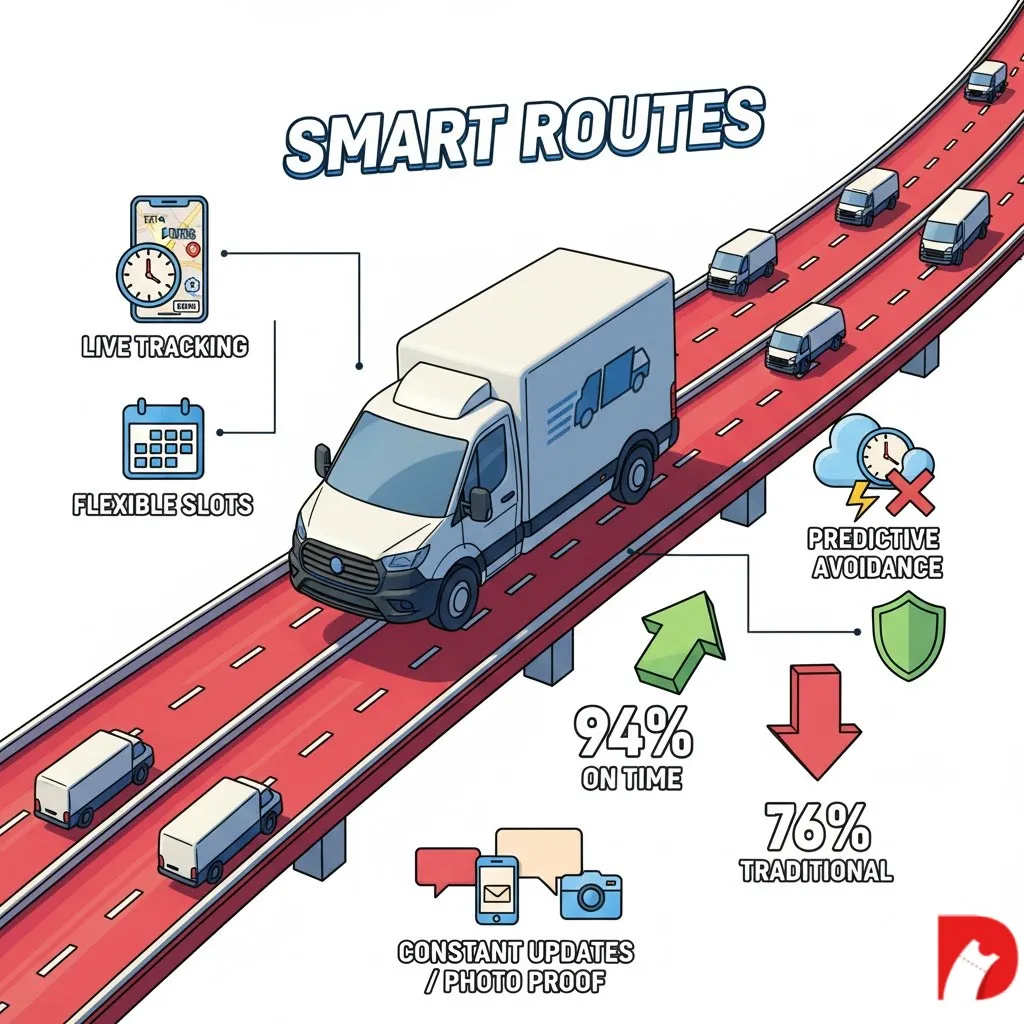
A last-mile delivery platform uses dynamic routing technology that recalculates the most efficient path continuously throughout the day.
In situations when the traffic on the M25 has amassed, or the weather has slowed down a specific stretch, the system will automatically divert traffic. This makes deliveries fly rather than crawling in a congested traffic among other reasons why 94% of deliveries are made on time relative to the 76% under the traditional technique are using the technology.
GPS-based real-time monitoring allows you to know precisely the position of your delivery driver and follow him/her on his/her way to your address. You receive the correct estimated arrival times that is updated after every few minutes or so you know whether you can run to the shops or not or whether you have to wait until the next 20 minutes. Such visibility does not mean that you are losing days of your life as you sit around waiting.
Flexible delivery times do not operate against your time. The contemporary services allow you to select an hourly or two-hour timeframe that fits your schedule, and it is not hard to reschedule using an app or website in case something happens. By controlling the time you take off a work you will not be taking any unnecessary time off as you will be able to choose an evening slot or even organize with your lunch time.
Predictive intelligence estimates the weather, traffic trends, and records of previous deliveries to establish any possible delays before they occur. When the system notices that trouble is brewing, it gives you a prompt warning to rearrange your plans and the system may even re-arrange your delivery to a more favorable time frame on its own without you even having to do anything.
SMS messages, email updates, and in-app notifications will keep you updated at every step, which enhances better communication. You can know when the driver is out of the depot, when he is half a dozen stops away, and when he is right at your door. In case you authorised a safe place, couriers are able to send you photos of the place they dropped the parcel and this gives you evidence of where the parcel was dropped.
Real Cost Breakdown for a Failed Delivery
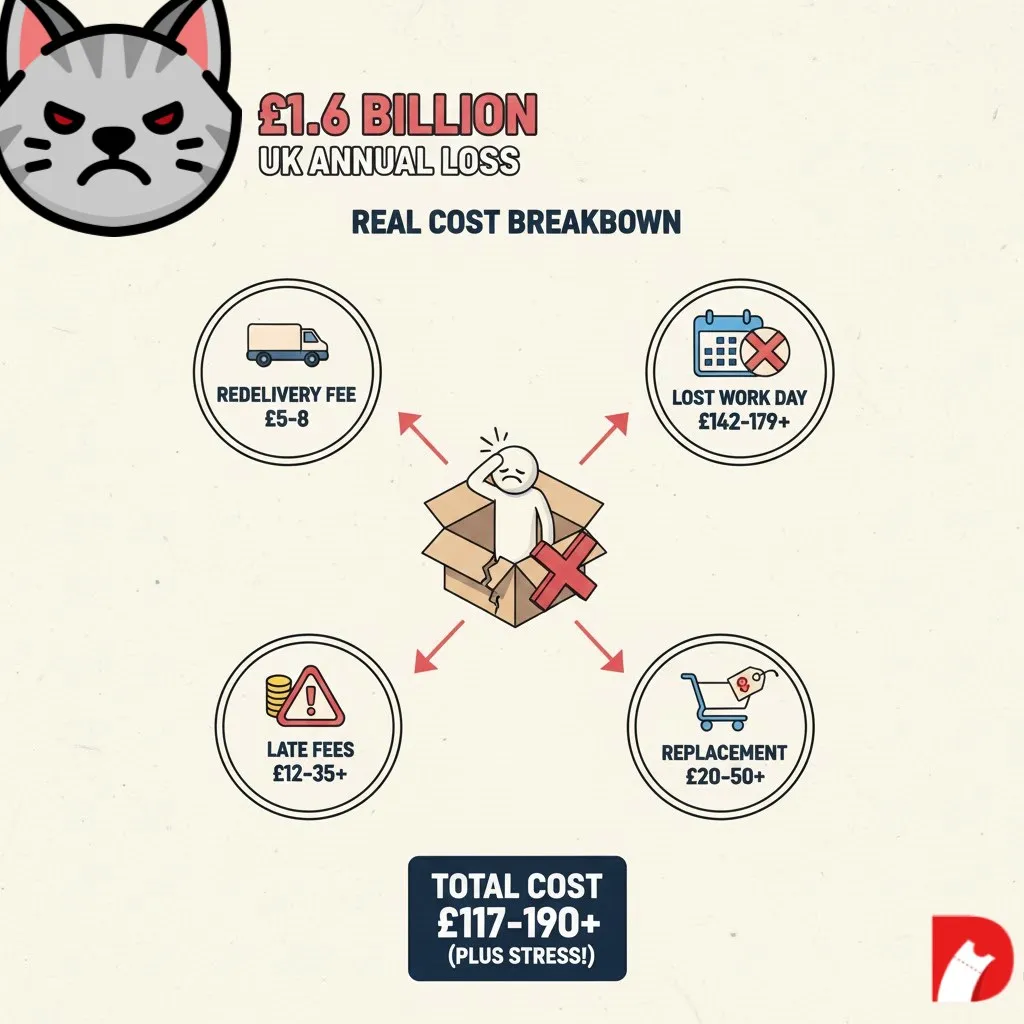
Logistics research indicates that each year the UK businesses lose approximately £1.6 billion in failed deliveries which are passed on to the shopper in terms of redelivery charges, time lost and the cost which we have just discussed.
A redelivery fee from some couriers runs between £5 and £8, though Royal Mail and Parcelforce offer free redelivery to your address. If you opt for collection at a local Post Office, there might be a small charge.
Taking another day off work costs you £142 to £179 if you’re a full-time employee earning around the UK median salary. Freelancers and contractors lose whatever they would have billed for that day’s work, which varies but often exceeds £200 depending on their rate.
Late payment fines hit your account when the item you needed to complete a transaction doesn’t arrive in time. Bank charges, utility late fees, or credit card penalties typically cost £12 upwards, with some reaching £35 for serious delays.
Buying a replacement locally at full retail price instead of the online discount you were supposed to get adds anywhere from £20 to £50 to your costs. Products in physical shops usually carry higher prices than their online equivalents, and you’re paying that premium because the original delivery failed.
Adding up just the core costs gives you a total somewhere between £117 and £190 for a single failed delivery, and that doesn’t include the stress, wasted time, or frustration involved in dealing with the situation.
The Secret Costs of Failed Deliveries
The most obvious cost is most likely to be taking a second day off work so as to wait until a redelivery. Looking at the average UK employee who earns about £37,400 a year working full time you can get the rough estimate of what you will lose between £142 and 179 a day in case you are asked to stay at home and not go to work. When you are a freelance or self-employed that figure can even increase more since there is no cushion of paid leave.
Late payment charges add up when the product that you have ordered should have helped you to settle a bill in time. The utility companies and credit card companies will normally impose a late payment fee of between £12 to 35 and that is money wasted since your delivery failed to arrive when it was supposed to.
The late arrival of grocery orders is a financial mess in itself. The case is when your weekly shopping is late by several hours and you have already planned to cook dinner or feed the family so you order takeaway or go out. It is an additional 25 to 40 dollars that you were not intending to use and your groceries may require restocking in case something went bad during the time spent traveling long distances.
Gifts that turn up a day late imply that you are purchasing a back-up present in the nearby area at any price that the store would demand, which is typically between 30 and 40 pounds in addition to what you have already spent to get the delayed gift. Being sold before your order could receive it would mean you are not getting the discount you would have believed you were getting, which is the point of having a promotion in the first place.
A Retailer’s Investment In Delivery Technology
As soon as you place your order, you can tell whether a retailer is current with their delivery technology or if they still operate on antiquated technology. You will know if a retailer is technologically out of date when you get a notification saying, “Your parcel will arrive between 8 a.m. and 6 p.m.” Then, after a lengthy absence of communication, the parcel will arrive at your doorstep. However, if you can see a live map of your driver’s location, the delivery company’s infrastructure is state of the art.
Precision is also a factor with outdated delivery systems. Companies with unrefined technology can only provide a delivery window if they input an entire day. This is because their software is incapable of forecasting when a driver will arrive. Companies with refined technology can predict delivery windows of a single hour on the clock or less. This is because their software accounts for live traffic, previous delivery time averages across the same route, and the driver’s location.
SMS messages and notifications from apps, one more indication, comprise automated updates, and depend on the retail’s system being properly interconnected with the current parcel carriers. If the retailer is only contacting customers to address complaints, there is no functionality behind the system.
Retailers That Actually Do This Well
- DPD may just have the best live tracking functionality in the UK courier space. Customers receive a notification for a one-hour delivery window, coupled with real-time tracking, which is a gold standard in the industry. They are also capable of changing delivery details on the fly without calling customer service, indicating that their systems are sufficiently sophisticated.
- Amazon shows customers the live location of the delivery driver once a parcel is out for delivery. Customers can view and rearrange their schedule within the delivery window by tracking the location of the parcel on a map, and are allowed to safe drop off any parcels. Customers also receive notifications on the driver’s location to reduce wait times for updated delivery arrivals.
- ASOS The United Kingdom branch of ASOS offers something called Precise Delivery, wherein customers are assigned a delivery hour window depending on their postcode, which they can monitor via a GPS tracking system called ‘Follow My Parcel’. Most of these deliveries are done through the courier DPD, which explains the even tracking system.
- Ocado controls their own delivery system, and therefore, they can design their own tracking system. It includes a live driver map, updates on the estimated delivery time, and allows the customer to change delivery instructions and accept alternative products while the delivery is on its way. Since they manage transport from their warehouse to the customer, there is less system confusion that can occur when multiple delivery services are involved.
- Argos offers something that can prove useful for larger items by sending a delivery text the evening before the delivery day, or the same day of delivery. They provide a 2 hour delivery window and alert customers when their delivery is 30 minutes away. Argos can send these notifications as their system permits for same-day deliveries, which they call Fast Track, and they even offer time slots to customers so they can pick a time that suits them.
- John Lewis also provides information before delivery, but this time for bigger items, such as furniture and appliances, and in a more precise manner. They send a text the evening before the predicted delivery, and in the morning of the delivery day, they send a text when the delivery vehicle has left the warehouse, and the delivery personnel call approximately half an hour before they arrive. They also send a more precise text the evening before delivery giving a 2 hour window for the whole delivery schedule.
What This Means When You Shop
If you come across two retailers with more or less the same item with the same price, check which one has more convenient delivery options before you make a purchase. Real time tracking, one hour delivery windows, easy and fast rescheduling of deliveries via an app showcases an investment in performance and operational efficiency. Lack of tracking, 8 hour delivery windows, and a long wait for a scan at the delivery location showcases the bare minimum investment for a packaged item order.
This becomes more critical if you really need to be present at the time of delivery, or when you order an expensive item that you do not want left unattended at the delivery location for a long time.
Annual Savings from Shopping with Reliable Deliveries
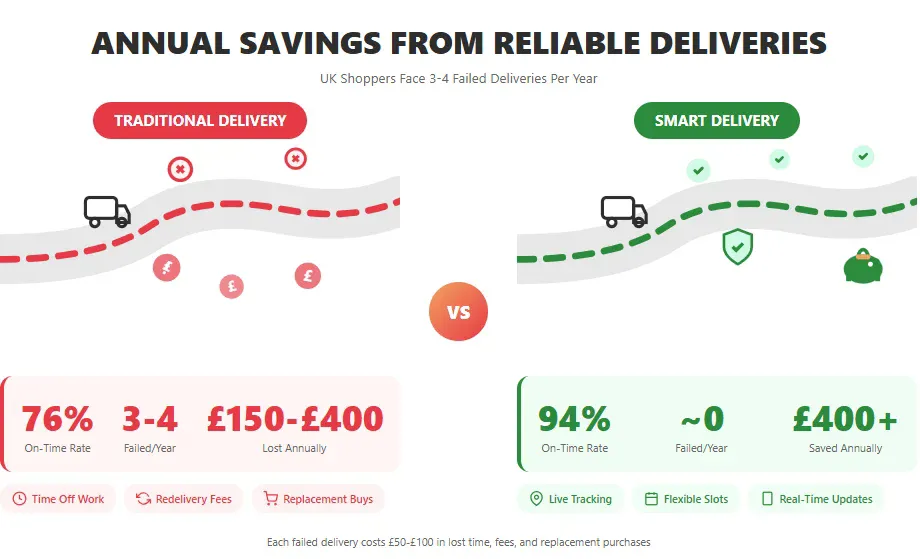
The average UK shopper faces somewhere between three and four failed deliveries each year according to logistics industry analysis. Each one costs you between £50 and £100 when you add up the time off work, redelivery charges, and replacement purchases you’re forced to make.
Multiply that out and you’re looking at £150 to £400 lost annually just because of delivery failures. For most households, that’s a significant chunk of money that could have gone toward better things, or simply stayed in your savings account.
Shopping with retailers who use reliable modern delivery systems cuts those failures down to nearly zero. When 94% of deliveries arrive on time instead of 76%, you avoid most of the costs associated with failed attempts. The difference in reliability translates directly into money staying in your pocket rather than going to courier companies, local shops charging premium prices, or your employer as unpaid leave.
The reduction in stress doesn’t have a clear price tag, but anyone who’s spent an entire day waiting for a delivery that never came or scrambling to find a last-minute replacement gift knows the value. Modern delivery technology removes that anxiety because you have visibility, control, and confidence in the timing.
Tips for Staying on Top of Delivery Tasks
Before ordering consider checking site reviews from Trustpilot for comments on delivery time and courier comments. There is a possibility that a retailer is selling great products. They may also be losing customer loyalty for using a horrible delivery provider. You’ll avoid a forgotten retailer or one that is selling products of questionable quality for a high price.
If possible, check delivery tracking multiple times during the day instead of just once. GPS delivery updates improve use within the tracking device or web page. Set notifications to avoid inactivity during important updates.
If offered, save preferred delivery options to your account, like safe places or alternate and neighbor addresses. Adding these preferences will let couriers know what to do in your absence, helping to avoid a delivery loss.
Look for retailers who subcontract to couriers that are using modern logistical systems. Instead of just going for the one that is cheapest. Delivery for only an extra £2 is a significantly better offer than losing £150 in time off work and a range of other inconveniences for a problematic delivery.
Membership services that offer premium delivery options, such as Amazon Prime, are only cost-effective if one orders at least weekly. For those who shop online infrequently and may place only one order monthly, the cost of the subscription fee outweighs the savings that one may accrue from delivery fees. Before committing to a subscription, consider how often you plan to order.
Making Delivery Reliability Part of Your Shopping Decisions
There is no doubting that delivery performance affects how much you pay for online shopping right alongside product/service pricing and delivery charges. If a retailer charges you 5 pounds less than competitors, but their delivery system fails half the time and ends up costing you 150 pounds in subsequent expenses, then you have no savings whatsoever on your order.
Modern delivery systems designed for last mile delivery are able to minimize the black hole of delivery failures and not only provide transparency, and most importantly, offer customers control over their delivery time. This is a system that works and is evidenced by the logistics companies that have a on-time rate of 94% or more as opposed to over 76% for most traditional networks.
The influence of your shopping choice is a direct demand for better and even more advanced delivery systems. When delivery systems of competitors shop are more efficient, retailers retail notice and are pressured to modernize their delivery system and even their whole supply chain to keep up. Every purchase you make by taking the delivery performance of a retailer into consideration rather than just pricing of the products is a clear signal that delivery reliability is important.
The next time you are comparing online retailers, you are encouraged to not only look at the product pricing but also the delivery performance. Look for delivery reviews, narrow time windows, real time tracking and advanced order management systems. These signals indicate an over investment to avoid delivery failure. This investment to avoid delivery failure means and translates into your savings.


