

Nobody sat down one morning and thought, “right, I fancy retraining in my thirties.” That’s not how it works. What actually happens is your energy bill lands, your rent goes up again, and you’re staring at a payslip that hasn’t moved in two years wondering where exactly everything went wrong.
Because the numbers don’t lie. UK inflation hit 3.4% in December 2025. Sounds manageable until you realise consumer prices have climbed over 20% in three years. Wages? Real growth of about 1%. One measly percent. A third of adults in Britain can’t cover an unexpected £850 expense. And the Joseph Rowntree Foundation reckons disposable incomes will keep sliding for the rest of the decade.
That’s the backdrop. That’s what millions of working people are dealing with every single month.
The Tech Layoff Fallout Nobody Talks About
In the meantime, there was something suspicious in the world of technology. The sector which was meant to be immune to bullets began to haemorrhage employment. An RSM UK survey found 74% of tech businesses cut between 5% and 25% of their workforce in 2024. Alone, almost 60,000 tech experts were rendered jobless in the same year. By 2025, it reached over 123,000 in 257 companies all over the globe. It is not much later than 2026, and already 38,000 more are gone.
Only 3% of surveyed UK tech firms made zero redundancies. Three percent.
This is where the interesting part comes in though. The displaced workers did not disappear. One massive segment of them shifted to cybersecurity, cloud computing, and AI. Not that they had always wanted to be threat hunters – that was where the money flowed.
The Gap That Won’t Close
The UK has a cybersecurity workforce shortage of over 11,200 professionals. Government data from 2025 showed 44% of British businesses lack basic cybersecurity skills. Not advanced stuff — basic. Configuring firewalls, spotting malware. The fundamentals.
And because demand outstrips supply so badly, salaries have been climbing while everything else in the economy stagnates:
- Entry-level SOC Analyst: £30,000–£42,000
- Mid-level Security Analyst: £45,000–£60,000
- Senior roles: £65,000–£90,000+
- London mean for core cyber roles: £69,800
The median cyber salary hit £48,900 in 2024 — a 9% jump from the year before. That’s a 12% wage premium over general IT positions. For context, the average UK salary sits around £35,000.
So there’s a gap. A big one. And it’s not closing anytime soon.
The £8,500 Question
And here is where the greatest part of people are caught. They type in the query how to enter into cybersecurity UK and at once, they bump into bootcamp advertisements. Makers Academy is seeking 16 weeks at £8,500. Ironhack charges £6,000–£7,000. General Assembly operates a 24 week programme that will cost you the same. University course? £9,250 per year, over three years. Almost 28 thousand pounds without even having purchased a textbook.
To someone who is already pushed by the cost of living the idea of spending £8 500 on a gamble in the career when the sun is shining is akin to borrowing an umbrella when the sun is shining and giving it back when it rains. As far as the maths is concerned it is not adding up when you are counting every penny.
But there’s another route that barely gets mentioned.
The Self-Study Path (And Why It Actually Works)
Microsoft’s SC-200 certification — the Security Operations Analyst Associate — costs £113 to sit in the UK. That’s the exam fee. The entire preparation material on Microsoft Learn is free. You can spin up a trial Azure subscription for nothing. Practice tests run about £20–£40.
Total realistic cost: £150–£200.
Compare that to £8,500 for a bootcamp and you start understanding why self-study certifications have become the quiet revolution nobody’s advertising. Nobody profits from telling you the cheap option works just as well.
What SC-200 actually covers:
The exam validates your ability to work with Microsoft Sentinel, Defender for Cloud, and Microsoft 365 Defender — tools used by 40,000 organisations worldwide. Microsoft Sentinel alone processes security data for companies across 65 global regions. Azure grew 39% last year and now pulls in over $75 billion annually. These aren’t niche skills. When 95% of Fortune 500 companies run Azure, knowing how to secure it makes you genuinely employable.
The study commitment:
Most candidates report 80–120 hours over 8–12 weeks. Evenings and weekends, basically. Three months of consistent effort for a credential that opens doors to £35,000–£45,000 starting roles. The exam itself is 40–60 questions covering three domains — threat mitigation through Microsoft 365 Defender (25–30%), Defender for Cloud (20–25%), and Microsoft Sentinel (50–55%). Pass mark is 700 out of 1,000. Renewal is free, annually, through an online assessment.
The ROI Nobody Can Argue With
Sums don’t lie. Somebody earning £28,000 in IT support who self-studies for SC-200 and lands a £42,000 SOC Analyst position has gained £14,000 a year. Their training cost was roughly £200.
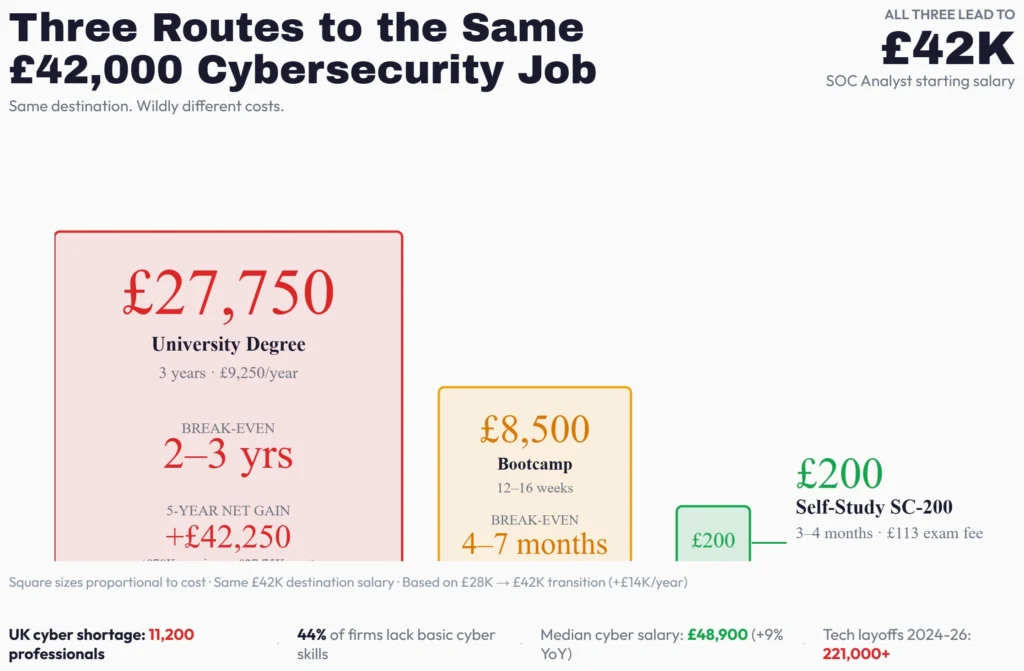
That’s a break-even point of about five days.
Over five years, that’s £70,000 in additional earnings minus £200 in costs. Compare that to the bootcamp graduate who spent £8,500 for the same £42,000 job — they’re £8,300 behind before they’ve even started.
| Route | Cost | Time | Break-Even |
| Self-study (SC-200) | ~£200 | 3–4 months | ~5 days |
| Bootcamp | £5,000–£8,500 | 12–16 weeks | 4–7 months |
| University degree | £27,750+ | 3 years | 2–3 years |
The penny wise, pound foolish trap runs both directions. Sometimes the cheaper option isn’t cutting corners — it’s just cutting out the middleman.
Free Options Most People Miss Entirely
This is the bit that genuinely surprises people. The UK government funds cybersecurity Skills Bootcamps that are completely free for eligible adults aged 19 and over. The City of London runs a 12-week Digital Skills Bootcamp at zero cost. A programme in London funded by the Mayor’s office and the Department for Education offers a 10-week cybersecurity bootcamp — free — with a guaranteed employer interview at the end.
Other free resources worth knowing about:
- Microsoft Learn — structured learning paths covering every SC-200 exam topic, entirely free
- TryHackMe — hands-on labs from £8/month, with a free tier
- Government Cyber Security Academy — no technical qualifications required to apply
- NCSC CyberFirst — courses and bursaries backed by GCHQ
- HackTheBox — free tier for practical security challenges
The information is out there. It’s just buried under paid adverts from bootcamps with bigger marketing budgets.
When Self-Study Isn’t the Right Fit
Fair doth fair In this way not all can go. Self-directed learning also requires discipline, which not all people possess, and there is no shame of acknowledging that. Bootcamp completion rates sit around 80%. Self-study? Significantly lower. That may be a good use of your personal money, in case you know that you will procrastinate in the absence of a structured classroom such as spending on that £6,000.
The networking, career services and CV help also provided in bootcamps are not provided during self-study. In case you have never worked in tech and require a hand-holding experience in getting your job application done, there is real value there.
However, when you are already in IT, already find it easy to read and study documentation, already checking your bank balance with one eye – the self-study certification path provides the same career result on a fraction of the cost.
Where This Leaves You
The cost of living isn’t going back to normal. Prices don’t reverse — they just stop climbing as fast. And waiting for things to improve is a strategy that’s never paid off for anyone.
There are 1000-+ vacancies in cybersecurity in UK currently. The wages are initially higher than in the other sectors of the mid career jobs. The entry cost can be as low as £113. The resources of the training are free. There are definitely programmes, funded by the government, and guaranteed interviews.
It has never been cheaper to bridge the gap between where you are and where you could be. Whether that will be three months of your evenings is a question for yourself only,–but at least here you now have the figures to make it out right.


