

The UK Gambling Commission holds the power to revoke operating licences under sections 116-119 of the Gambling Act 2005. This happens when operators fail regulatory duties around anti-money laundering, player protection, source of funds verification, or suitability of controllers. License revocation means the operator can no longer legally offer gambling services to British customers.
What follows are five verified cases of full operating licence revocations or effective shutdowns (surrender following suspension) from the past five years. Each case connects to specific regulations the operator failed to follow.
Before I begin, I would like to say special thanks to team Wagerland, for providing me information for this article.
Operators Shut Down by UKGC (2019-2025)
| Operator | Date | Prior Fine | Violations | Outcome |
|---|---|---|---|---|
| Silverbond Enterprises Ltd (Park Lane Casino) | 4 Nov 2020 | £1.8m (Sep 2019) | AML failures, duty of care lapses, unauthorized change in corporate control, unsuitable controller. | Operating licence revoked effective 18 Nov 2020. Casino closed. |
| MaxEnt Limited (Slotty Vegas) | 5 Jun 2019 | None specified | Source of funds concerns post-corporate control change, unsuitable controller, conflicting information provided, failed full disclosure. | Remote casino and software licences revoked. Operator withdrew from UK market Jan 2020. |
| In Touch Games Limited (mFortune, PocketWin, etc.) | 3 Sep 2023 | £6.1m (Jan 2023) | AML breaches, social responsibility failures, unfair terms, key event reporting lapses. | Licence suspended immediately, then surrendered 5 Sep 2023. All sites ceased GB operations. |
| TGP Europe Limited | 15 May 2025 | £316k (2023) | AML failures, inadequate due diligence on white-label clients, ineffective risk assessments, source of funds verification lapses. | Ordered to pay £3.3m fine. Licences surrendered. Exited GB market. |
| Fairbetter Limited | 12 Dec 2024 | None specified | Regulatory breaches under s116 review, non-compliance leading to unsuitability. | Operating licence revoked. |
Silverbond Enterprises Ltd (Park Lane Casino)
Park Lane Casino operated as an upmarket members-only venue in London’s Mayfair district, inside the Hilton Hotel. Annual membership cost £1,000. The clientele included millionaires and high-rolling gamblers who expected discretion.
The problems started well before the licence revocation. In 2016, the UKGC began reviewing Silverbond’s licence after concerns emerged about check-cashing services offered to VIP gamblers without adequate source of funds verification. Park Lane staff were allowing customers to cash cheques without proper due diligence on where the money came from.
In September 2019, Silverbond received a £1.8 million fine for social responsibility and anti-money laundering failings. One customer had displayed violent behaviour, threatening staff and damaging property. The operator’s compliance procedures were deemed inadequate. Enhanced due diligence had not been carried out on 61 customers despite obvious warning signs.
The final blow came with a change in corporate control. Latvian businessman Vasilijis Melniks, who had owned Silverbond through Eiroholdings Invest, was investigated by Ukrainian authorities over alleged money laundering and embezzlement of around $64 million from a state-owned energy company. His assets were seized.
When ownership transferred in 2018, the new controller’s identity remained murky. The UKGC concluded it was not satisfied with the source of funds used to acquire and support the business, nor could it establish where future profits would be paid. Helen Venn, UKGC Executive Director, stated: “We revoked this licence because we are not satisfied as to the source of funds used to acquire and support the Licensee at the time of the change of corporate control.”
Regulations breached:
- Section 102 of the Gambling Act 2005 (change of corporate control notification requirements).
- Licence Condition 12.1.1 (anti-money laundering policies and procedures).
- Social Responsibility Code Provision 3.4.1 (customer interaction).
MaxEnt Limited (Slotty Vegas, BetAt)
The Slotty Vegas and BetAt brands of the online casinos were run by MaxEnt based in Malta. In May 2018, the company bought NRR Entertainment, which led to the regulatory examination that would eventually shut down its business in the UK.
The concerns by the UKGC were completely based on the process of acquisition and not on the way the customers were being treated. Following a hearing by the Regulatory Panel the Commission made the decision that, had the new controller been in command at the time the original application was made, the operating licence would not have been granted.
The special problems: MaxEnt was incapable of properly recording the origin of money that was used to acquire NRR Entertainment. The new controller gave contradictory information when questioned by UKGC and was unable to be full and frank in its dealings with the regulator. The documentary evidence loopholes were the gaps between the transition period and the new management.
The revocation was first appealed by MaxEnt, and stayed pending the result. But in January 2020, the company declared that it will completely quit the UK market due to Brexit. This appeal was later withdrawn.
MaxEnt in a statement explained that they made the decision with a heavy heart, but Brexit had rendered it not worth staying in the UK market any longer. The company shifted to other markets such as Germany and Finland.
Regulations breached:
- Section 102(4)(b) of the Gambling Act 2005 (licence revocation for unsuitability).
- Corporate control notification requirements.
- Full and frank disclosure obligations to the Commission.
In Touch Games Limited (mFortune, PocketWin, Mr Spin, Dr Slot, Casino2020, Cashmo, Bonus Boss, Jammy Monkey, Slot Factory)
In Touch Games was a West Midlands based operator that had been operating since 2007. Their flagship brand mFortune was the first mobile gaming in the UK and the company went on to have a total of nine gambling websites with a customer base of about 5 million in the UK.
Problems of regulation over the years. In 2019, In Touch was fined £2.2 million due to regulatory failures. An additional penalty of £3.4 million and a warning was imposed in 2021 following an assessment by the UKGC that found failures in their social responsibility, money laundering and marketing. Then in January 2023, a £6.1 million fine for yet more AML and social responsibility failings.
Total fines since 2019: £11.7 million.
The January 2023 enforcement detailed specific failures. In Touch had not interacted with customers showing erratic and extended play patterns. They had not verified customers’ income and expenditure despite obvious signs of problem gambling. Policies and procedures to address money laundering and terrorist financing risks were inadequate. Staff were not properly trained on UKGC guidance or the significance of politically exposed persons.
Kay Roberts, UKGC Executive Director of Operations, said at the time: “Considering this operator’s history of failings we expected to see significant improvement when we carried out our planned compliance assessment.”
On 1 September 2023, the UKGC suspended In Touch’s licence with immediate effect. The Commission suspected activities contrary to the Gambling Act, non-compliance with licence conditions relating to money laundering, fair and transparent terms, and failure to report key events.
Four days later, In Touch surrendered its licence entirely. An internal message explained: “We regret to inform you that we have taken the difficult decision to surrender our licence with immediate effect.” Customers could still withdraw funds, but the sites ceased accepting deposits immediately.
The company had been acquired by Skywind Group in June 2022, just 15 months before the shutdown. The legacy compliance issues from years past ultimately proved fatal.
Regulations breached:
- Licence Condition 12.1.1 (AML policies and procedures).
- Social Responsibility Code Provision 3.4.1 (customer interaction).
- Licence Condition 15.2.1 (fair and transparent terms).
- Licence Condition 15.2.2 (key event reporting).
TGP Europe Limited
TGP Europe was not like other conventional gambling companies. The company operated a white-label business model based in Douglas, Isle of Man, with it supplying gambling infrastructure under the branding of other businesses. TGP had an UK licence of about 30 sites.
The regulatory issues were systemic. TGP did not conduct adequate due diligence of the business partners with its licence. Whites-label due diligence was poor. Risk analysis did not work. Source of funds verification processes did not work.
This was not the first crime by TGP. In 2023 the company was fined £316,250 as a result of its failures such as not properly taking into account money laundering risks presented by business-to-business relationships and ineffective policies on due diligence before white-label agreements.
Regardless of that warning, the problems persisted. The investigation by the UKGC revealed that TGP had not properly applied the enhanced due diligence measures, as stipulated in its own AML policy. There was no proper scrutiny of the information they received through third party.
In May 2025, the UKGC ordered TGP to pay a £3.3 million penalty and make “significant improvements” if it wanted to continue trading in Great Britain. TGP chose instead to surrender its licence and exit the market.
The shutdown had significant knock-on effects. Several Premier League football clubs had sponsorship deals with TGP-affiliated brands: AFC Bournemouth, Fulham FC, Newcastle United FC, Wolverhampton Wanderers FC, and Burnley FC. The UKGC wrote to each club warning them of the risks of promoting unlicensed gambling websites. Club officials were advised they could face prosecution and imprisonment if they continued promoting the now-unlicensed brands.
John Pierce, UKGC Head of Enforcement, stated: “This case involves a gambling company that was unwilling or unable to meet the regulatory standards we expect from our licensees. It is right that they have now exited the British market.”
Regulations breached:
- Licence Condition 12.1.1 (AML policies and procedures).
- Licence Condition 12.1.2 (due diligence on business relationships).
- White-label oversight requirements.
- Enhanced due diligence obligations under own stated policies.
Fairbetter Limited
On 12 December 2024, after a section 116 review, Fairbetter Limited was revoked on the grounds of its operating licence. The particular breaches that have been the basis of revocation have not been published in detail other than as regulatory breaches and non-compliance that results in unsuitability.
Section 116 reviews take place when the Commission has a reason to suspect that an operator is not suitable to hold a licence, that an operator has violated the terms of the licence, or that the operator has conducted themselves in a way that is against the Gambling Act. The Commission is able to do an in-depth review and then make a decision on the revocation.
Their licence was revoked by regulation, in contrast to some other operators who gave up their licence when they became the subject of enforcement measures.
What These Cases Tell Us About UKGC Enforcement
The five shutdowns share common themes:
Source of funds failures. Both Silverbond and MaxEnt lost their licences primarily over concerns about money used in corporate acquisitions. The UKGC demands full transparency about who owns gambling businesses and where their money comes from. Opacity is not tolerated.
Repeated offences. In Touch Games and TGP Europe both received substantial fines before their licences were removed. The UKGC gives operators opportunities to improve following initial penalties. When improvement does not materialise, suspension and revocation follow.
AML and social responsibility. Anti-money laundering and player protection failures appear in nearly every case. These are not optional extras. They are core licence conditions that operators must meet consistently.
White-label risks. TGP Europe’s shutdown demonstrates that operators running white-label businesses carry responsibility for their partners’ conduct. Inadequate due diligence on third parties using your licence can bring down the entire operation.
How to Verify Legitimate Operators
Before depositing money with any gambling site, checking their regulatory status takes seconds. The UKGC maintains a public register where anyone can verify whether an operator holds a valid licence.
What to check:
- Valid UKGC licence number displayed on the website footer.
- Licence verifiable on the UKGC public register (gamblingcommission.gov.uk).
- Clear terms and conditions for bonuses and withdrawals.
- Responsible gambling tools visibly accessible.
- Transparent complaints procedure with escalation to an approved ADR provider.
Warning signs:
- No licence number displayed or a number that does not verify.
- Licence from jurisdictions with minimal oversight.
- Recent enforcement actions appearing on the UKGC sanctions register.
- Vague or constantly changing terms.
- Difficulty withdrawing funds.
The operators shut down by the UKGC demonstrate what happens when compliance fails. Customers of In Touch Games lost access to their favourite sites overnight. Park Lane Casino members found the doors closed. Players at Slotty Vegas had to withdraw funds quickly before the shutdown completed.
Checking an operator’s regulatory status before depositing protects against being caught in similar situations. The UKGC register shows not just current licence status but also any warnings, additional conditions, or ongoing reviews. An operator under section 116 review is already in regulatory trouble, whether or not that has been announced publicly.
The Regulatory Framework
The Gambling Act 2005 provides the UKGC with substantial enforcement powers:
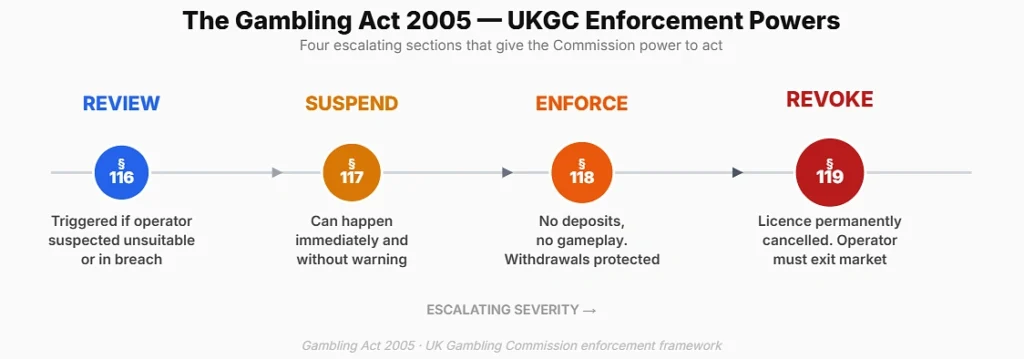
- Section 116 allows the Commission to review a licence if it suspects the operator is unsuitable, has breached conditions, or has engaged in activities contrary to the Act.
- Section 117 permits suspension of a licence pending the outcome of a review. Suspension can happen immediately and without warning if the Commission considers it necessary.
- Section 118 governs the suspension process and its effects. Suspended operators cannot accept deposits or allow gameplay, though customers must be allowed to withdraw funds.
- Section 119 covers revocation. The Commission can revoke a licence if satisfied the operator would not meet the criteria for a new licence application, or has failed to comply with conditions.
The existence of these powers is a result of the fact that gambling regulation is in the public interest. Harms can only cause damages to the business when the operators cannot stop money laundering or safeguard the vulnerable customers. The whole industry is affected negatively.
The five operators that are suspended between 2019 and 2025 are the gravest implementation consequences that can be given to the UKGC. The cases related to either a continued non-compliance despite being warned earlier, underlying issues regarding ownership and financing or failures so serious that the Commission did not have any confidence in the suitability of the operator at all.
To the customers the message is clear: only play with licensed operators properly, ensure that they are regulated before putting money in and watch the news on the action taken. The subsequent shutdown may happen to any operator which does not fulfil its duties.


